
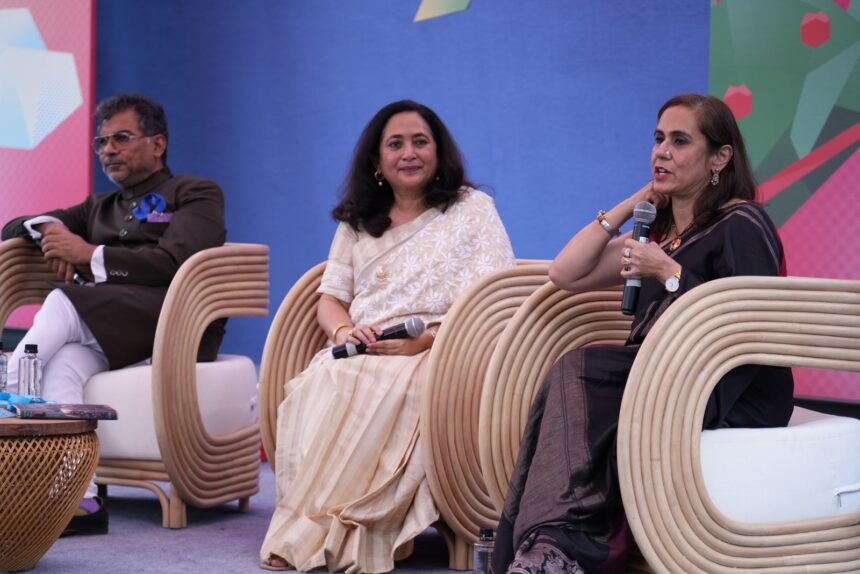
Sadhana Rao initiated the panel, stating that arts and creativity are not defined by a set flow but find their motive in the act of flowing itself, unbound by discipline or stridency. This panel consisting of two distinct voices from different artistic fields – one a chronicler of crafts and fashion, and the other an acclaimed actor, both having a shared current of the arts, came together to discuss reshaping the contours of Art as it evolves.
Shefalee opened the session with the question posed to her, on how her approach to fashion has been very different, as a chronicler of the crafts, as well as a fashion journalist. She defined her motivation coming from common journalistic tendencies of wanting to do what others can’t and create a mark as a creator – to treat the industry as a genre – finding depth, analyzing and going beyond the surface, finding the human beneath the story, which is overcoming the typical stereotypes associated with the industry of glamour, celebrity endorsement, sponsorship and the gloss. She goes on to say that fashion is just not the sheen, it goes beyond it, for her it is about Multiplicity, Diversity, and versatility.
The discussion later focused specifically on Khadi. Shefalee addressed the dichotomy between craft and fashion, quoting from her own book “What can Khadi’s fashionisation cost India?” She discussed about the need to fashionise the appearance of the fabric which has a history of national appeal and sentiment, versus modernizing the process by upscaling the spinner and enabling him / her with more opportunities rather than only limiting efforts to create ramp looks and marketing campaigns. Vasudev opined that modernizing the fabric was necessary without “fashionising” it, advocating that its original ethos, rawness, and unevenness be left intact.as she sees it as a story, a way of living symbolic of many ideas. She cautioned against templatizing it, to make it more relevant to the times.
Sadhana then asked Danish, about his journey of moving from a banking background to theatre, and whether it was a gradual shift or an overnight decision? He narrated about his gradual shift to the arts, explaining his disillusionment in the banking sector led him to explore different facets of himself beyond his day job. Danish, through his talent of a mimic joined an amateur theatre group, where he worked for three years along with his banking profession, before jumping into being a full time actor.
Taking the discussion further, Sadhana sought Danish’s point of view on the dichotomy between theatre and films. He picked up on the unevenness of the Khadi fabric from Shefalee’s discussion, describing how it is quintessential to the fabric’s character, and compared it to languages stating that that how taking away a community’s language is stripping them of its quintessential character. He drew parallels with how english with the brush of reach, is pushing away all languages into a vernacular set.
Danish then differentiated between the two mediums. He explained that a theatre performance requires a wider, more physical depiction as the audience views the actor in a wide frame. In contrast, film relies on mid-shots and close-ups, requiring the actor to be more emotive than physical. The setup, he explained dictates the actor’s adjustment.
Danish also spoke about his association with the revival of the Dastan – e- Amir Hamza, the traditional art of Urdu storytelling, and his efforts to bring the centuries old oral tradition back into contemporary cultural context since mid 2000s.
Closing the discussion with the panellists, Danish addressed the question on mainstream entertainment becoming algorithm based, and whether space still exists for alternate voices and forms. He stated that no art form exists in a silo; all art survives within a milieu and requires dialogue with the audience. He further commented that the norm of social media and app-based content has made human interaction reductive, pointing to the pervasive pressure on content—including news, lectures, and editorial work—to becoming manoranjan (entertainment). This pressure, he noted removes space for hard conversations and silences, thereby hindering the audience’s ability to think or feel. He concluded that the arts must offer alternate sources of discussion and storytelling—through theatre, indie cinema, and symposiums—to foster growth and thought.
Shefalee responded to the closing question on the underinvestment of policy makers in the craft sector and if it was a Que Sera Sera situation. She stated that “handmade” has become a contemporary buzzword, similar to “sustainable” and “green,” but questioned the depth of actual investment in initiatives versus surface-level promotion. In the promotion of handmade, she questioned whether the power loom artisan is being relegated to a second-grade status and pointed to the “politics of appearance” inherent in the “Idea of Handmade.” This politics, she argued, diverts allocated funds away from addressing issues such as gender disparities, wage gaps, and the lack of recognition for skill over labor. She urged a more careful investigation into where allocations are reaching and to what end. Shefalee concluded on a positive note, observing a growing interest in the subject, suggesting a positive shift in the politics of handmade in the coming years.
The session concluded with the shared consensus among the panellists that genuine interest exists in different dialogues, performance spaces, and the handmade sector. This interest, they agreed, is opening new avenues for “coloring outside the prescribed lines” of art and entertainment, allowing audiences to engage with art for art’s sake.
Disha Bhandari
Disha Bhandari is an Arts & wellness enthusiast, having spent over a decade in corporate leadership roles spanning across marketing and strategy. She is currently working as an art therapy practitioner curious about the working of the human mind, and how culture and nature impact things at large. She runs a company called Buoyant Living www.buoyantliving.com where she creates programmes for Individual growth & change in order to bring about a transformation in behaviour and action, which creates an impact on the environment at large. She loves reading, blogging and trekking, and lives in Bangalore.