
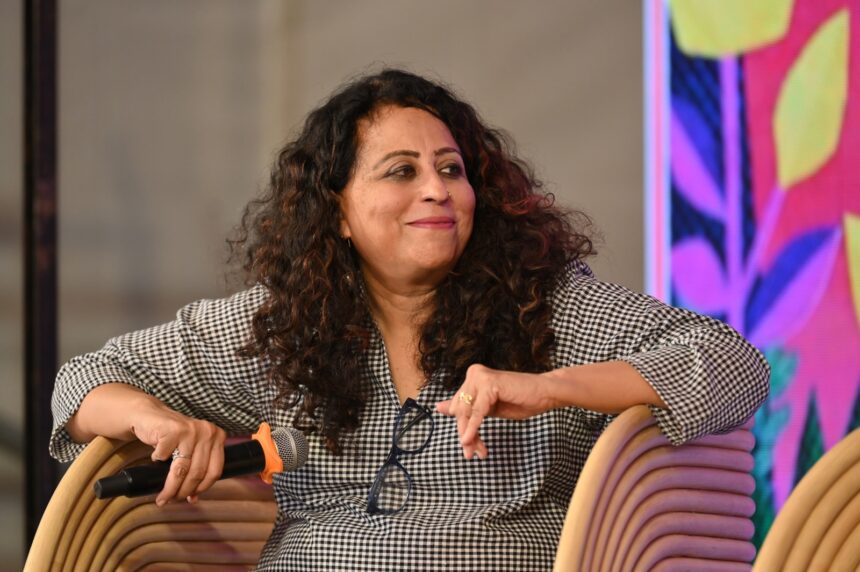
Some sessions feel like conversations, and some feel like quiet revelations. Just Like a Woman, moderated by Diaa Hadid, began with a laugh when she said, “Do not worry, we are not talking about polyamory today,” and from that moment the room settled into an easy intimacy. The session brought together Anita Nair and Gayathri Prabhu to speak about women, memory, and the ways in which life turns into literature.
Gayathri Prabhu began with her book A Genre of Her Own, which grew from a question she carried for years. “Who are my literary mothers, and why do so many of them disappear from the histories we inherit?” She explained how she created clusters of Marathi, Bengali, Anglophone, and Urdu women writers, and followed the faint trails each of them left behind. She spoke of Tara Bai Shinde, whose one fiery text was filled with righteous anger. She spoke of Rakhmabai, who chose prison over conjugal obedience. She spoke of diarists like Binodini, who wrote because that was the only space available for their thoughts.
She described her research as following breadcrumbs in a forest, where nothing is linear and nothing is preserved neatly. Women wrote diaries, letters, and memoirs not to be literary but to survive, to breathe, to create a small space inside a world that kept tightening around them. Much of their writing was dismissed as domestic or trivial, yet when read against the grain, these fragments form the earliest feminist life narratives in India. Gayathri said that being unaware of your own caste is a privilege, and many of these women wrote without that privilege and still wrote anyway.
The conversation shifted to Anita Nair and her book Why I Killed My Husband. Anita shared how the story began as an audio piece and slowly became a novel about joy, pressure, and the quiet violence that builds inside the walls of a home. She spoke about how she was scammed in April 2024, and said, “I knew I had to write about it, because if I did not write it, I would carry the feeling forever.” Writing became the only way to reclaim something that had been taken.
Diaa asked how she enters the minds of her characters, and Anita answered with a clarity that held the room. She said she has to shed herself first. She has to find where she sits inside the character, and once she does, the story begins to breathe. She spoke of how politics shapes personal life more deeply than we admit, and how our decisions are influenced in ways that cannot always be called nation building. She also spoke of the quiet fear that lingers even in a democracy, where people can still land in jail without crimes proven.
When the conversation returned to Gayathri, she spoke of women who entered print through the urgency of their own lives. Some acted on stage by impersonating men because that was the only way to earn a living. Some learned to read in secrecy. Some left only a few pages behind, yet those pages carried the weight of entire lives. She said the joy of her work was in finding the subtext women slipped between the lines, the places where their real selves quietly surfaced.
What connected Anita and Gayathri was their way of reading the world. Both pay attention to what is unsaid, erased, or overlooked. Gayathri reads against the grain to uncover the subtext. Anita listens to the silences inside her characters until they reveal their truth.
When asked to choose a favourite among the women she researched, Gayathri said she could not, because choosing one would mean betraying the others. That line stayed with the room.
Just Like a Woman did not try to glorify women or reduce them to symbols. It allowed them to exist as they are. Complicated, resilient, afraid, hopeful and often writing even when nothing around them encouraged it. The session reminded us that history rarely preserves women, but literature always has, as long as we are willing to look for them and listen.
Sharmila Giduthuri
Sharmila works in the automotive domain as a Senior Research Engineer at Mercedes Research and Development. She has been an active member of several non-profit organisations since 2019. She is currently writing her first book and also works as a freelance graphic designer.