
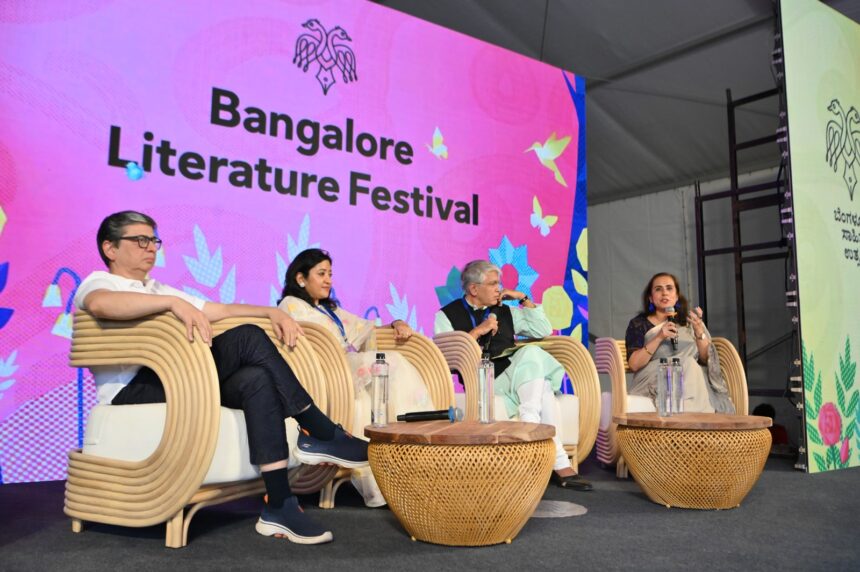
Manish Sabharwal opened the session titled “The Shape of Us as a Nation,” introducing a panel featuring Santosh Desai, Gazala Wahab, and Shefalee Vasudev. The panellist’s offered distinct perspectives on the nation’s character and evolution.
Defining the Nation’s Shape
Santosh in his straight shooting style started by saying that it is a very open ended question, and a nation cannot have one shape, it is a process, He analogized this process to water flow, where sediment (invisible undercurrents like caste, social norms, culture, and religion) interacts with the flow (visible structures: institution, government, policy, judiciary, media, politics, and technology).He noted that forces of change reverse these interactions, observing that society now transforms politics, rather than politics transforming society. He concluded that if forced to assign a shape, the nation resembles a delta, where the “waters of change have become sluggish.”
Manish then asked Gazala Wahab if “shapes of India” should exist at all. Wahab, author of The Heartland of India, affirmed that the nation possesses many shapes, reflecting its diversity. She stated that we have celebrated diversity as a nation, and these diverse groups have been working towards the larger interest of the nation, which is what has made the country what it is. The challenge therefore comes, when uniformity is thrust upon the nation, and our country is battered to a Uniform shape, giving the example of the British era. If such a context is forced on a country like India, it will lose its essence, and there will be consequences of marginalized communities driven further to the margins, which is going away from our core essence of celebrating diversity. In essence, she was of the opinion that there cannot be just one shape of us.
Shefalee who runs Voice of Fashion, said that she sees the Shape of our Nation, as a Blood Pressure Monitor – reading going between the highs and the lows, stating a paradox between hopes & hypocrisies, and the many performative anxieties existing in the nation, layered with cultural nostalgia. Vasudev characterized the nation as anxious and restless, simultaneously turning inward to embrace Indian identity and moving outward to adapt to changing diasporas, like an “octopus, having multiple tentacles.
Determinants of National Identity
The moderator then posed a pointed question concerning what exactly shapes the nation: is it language, religion, music, food, class, or caste?
Ghazala went ahead and said that experience is the biggest determinant of what shapes us. We can be consuming the same food, wear the same clothes, speak the same language, but what is the experience of that interaction is what shapes us. She was prompted by Manish to ask her view on religion and caste as an influence on what shapes us – to which she answered that they are shaping us as a nation more than ever before. She spoke about Law making and law enforcement shaped by Religion and caste and gave example of how Uttarkhand has passed the uniform civil code, when it was the prerogative of the central govt, and how law enforcement differs across religions.
Santosh strongly agreed on the role of religion and caste, attributing their influence to political agendas that determine rooted identity.He went on to add that technology has the power to influence us beyond politics and religion, and that it lacks cultural context on identity. It is a great equalizer and focused on the Individual more than a collective – making it an instrument of identity. The mobile phone for example makes an individual feel important beyond his religion, caste or background. He pointed out that it makes the individual the hero, and everything else is incidental, for example when taking a selfie, the Taj Mahal is a prop, while the person taking the picture is the center. He concluded that the simultaneous pull of politics and caste alongside the influence of technology propel the nation from the past into the future, leaving it in a state of vertigo, unsure of direction.
Manish then pivoted to Shefalee Vasudev, asking her about politicians’ self-presentation through clothing. She started by stating that the politicians are definitely dressing up better than earlier, and are creating new identities for themselves, by wearing symbols of India with ease – like a scarf, with lotus symbol, and leading the bandwagon is our Prime Minister who stages his presence using clothing as a powerful tool, whether it is a naga shawl, or a peacock feather in his headgear. She remarked humorously that there may be a Museum for Narender Modi’s outfits! She was of the opinion, that while politicians incorporate the symbols of India in their dressing, they still insist on wearing white kurtas and stereotypical outfits on every occasions. While the outside India is shining with toxic positivity, under the banner of “All is well” politicians remain caught up in the rigid trappings of India’s past while addressing the India of the future.
Assessing Progress: Better or Worse?
The final discussion hinged on Manish’s question: are things getting better or worse in India compared to the past?
Santosh began by stating that many things are working better for us as a nation such as everyday facilities, ease of life be it in transport, service providers, E-commerce, UPI , more financial inclusion. However he noted that many things are worse than earlier on the systemic front.
The pointed to a step-by-step dismantling of institutions on several fronts such as the effectiveness of the Election Commission, the judiciary becoming more timid, and media functioning more as a business than a pillar of strong reporting. This he argued, questioning the foundation of our democracy, and raises concerns about whether the nation weakening on that front.
Shefali added that she agreed with Santosh on the areas showing improvement and further highlighted the rise of the “bad ass girl” among classes, especially seen across domestic workers, adiwasi girls and the women wrestlers, who are loosening the fabric of gender stereotyping. She described it as a “rising of a kind”. She also spoke about the worsening living conditions for many communities and the continued existence of manual scavenging, stating that these realities represent the nation’s ugliest face.
Gazala opined that while some things are working, the aspects that are worsening far outweigh the improvements. She talked about the academic institutions focusing primarily on skilling the workforce rather than nurturing intellectual thinkers who build enterprises. She pointed on the nation earlier bound to the land by Idealism – like the Nehruvian philosophy, but these systems seem to be outdated and not prescribed by anyone, which is loosening the fabric of the nation, and the power for the collective weakening. Lastly she pointed on the Media, which was unbiased and had the ability to take on Governments and point their misdoing – quoting Rajiv Gandhi’s time, when the media had the power of picking out their misdoing’s, and that the people got a more unbiased view on the state of affairs, comparing to the present state of affairs, where not a single allegation has been pointed on the Current government, giving the people a biased view.
The session concluded after a round of questions from the audience.
All in all, a very invigorating discussion with diverse viewpoints on the shape of the nation and whether its current state is better or worse, articulated by the panelists from varied backgrounds and experiences.
Disha Bhandari
Disha Bhandari is an Arts & wellness enthusiast, having spent over a decade in corporate leadership roles spanning across marketing and strategy. She is currently working as an arts based mental wellness practitioner curious of the working of the human mind, and how culture and nature impact things at large. She runs a company called Buoyant Living www.buoyantliving.com creating programmes for Individual growth & change in order to bring about a transformation in behaviour and action, which creates an impact on the environment at large. She loves reading, blogging and trekking, and lives in Bangalore.