
So, she killed him
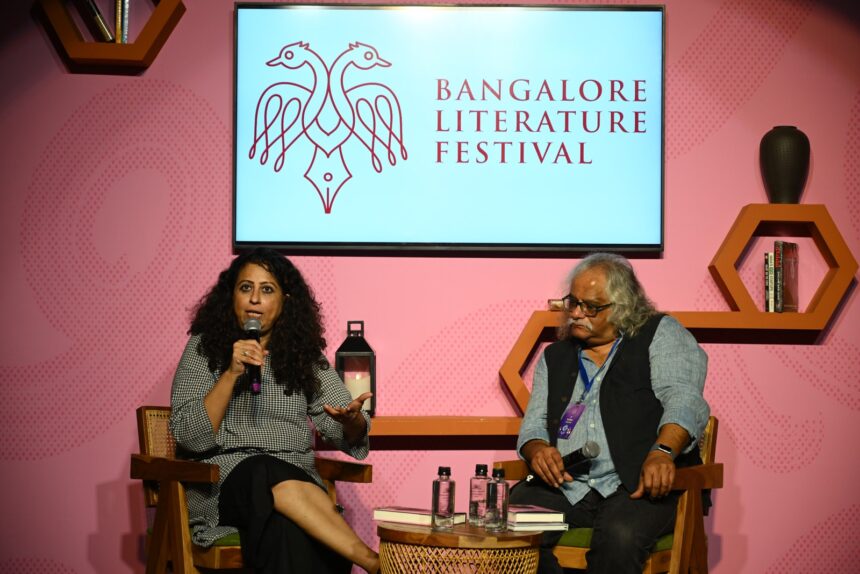
Imagine walking into a literary session thinking it’s just another author talk, and then ten minutes in you’re already questioning politics, marriage, guilt, class, caste, gender, and life. That’s exactly what happened at the session on Why I Killed My Husband by Anita Nair, in conversation with K. Sridhar. And before you judge that title too quickly, trust me that’s the whole point.
Anita Nair spoke about how the state of the nation itself triggered the book. Not just one event, not one headline, but the general atmosphere we’re living in—the frustration, the silence, the anger that keeps building quietly. She said the idea was to take an already existing political narrative and blend it with a deeply personal one, because after all, politics doesn’t stay in parliament; it sits at our dining tables too. The book is crime fiction, yes, but not in the usual “who-done-it” sense. It’s more like “why-done-it,” and that makes all the difference.
The protagonist is a regular middle-class Tamil woman, not someone extraordinary, not a rebel, not a criminal in the stereotypical sense. And yet, the story opens with that shocking line: “I should have killed my husband on the wedding day.” No build-up, no apology, no guilt, no dramatic crying, just a very chatty, casual confession. And that’s what unsettles you. She talks without remorse, without regret, almost like she’s explaining why she didn’t like a cup of coffee. You’re left wondering how bad does life have to get for murder to feel logical?
Anita Nair explained that the last straw for the murder is demonetization, which sounds absurd until you sit with it and realize how political decisions really do creep into the most personal spaces. Suddenly, this isn’t just a crime story anymore; it’s a story about how the nation enters a marriage, a kitchen, a bank account, a woman’s body, and her anger. She also pointed out how even something as basic as identity shifts—for instance, how Brahmin women are given different names after marriage—how labels quietly rearrange power. The book keeps circling around these invisible structures of class, gender, caste, and religion, never shouting, just constantly reminding you they’re there.
One of the most interesting things she said was about whether women artists are given the same space as men—whether women’s stories are allowed to be violent, angry, messy, and morally grey without being judged. The book is structured almost like a musical composition, where you slowly see the transition of the protagonist from a wide-eyed girl into a cold woman. And Anita doesn’t want you to just watch her—she wants you to understand her, to sit with her choices, to feel why she did what she did, and maybe even question if, in her world, it felt justified.
Then there are characters like Shri Raman, who does absolutely nothing with his life, happily surviving on inherited money—the very image of a comfortable, patriarchal Malayali man. His presence in the story shows how entitlement doesn’t always look violent; sometimes it looks lazy, casual, and self-satisfied. And the way power operates is so subtle—in how men approach women, in how silence works, and in how control doesn’t always announce itself loudly.
She spoke about settings too—fields of flowers, movement from south to north, and how even landscapes carry power equations and myths within them. The mention of the Hathras rape case in September 2020 was especially heavy, and the fictional village of Balarama near Hathras became a space where reality and storytelling collided uncomfortably. At that moment, the room went very quiet.
Someone asked a really interesting question—what if the title were reversed? What if it was why I killed my wife? Anita smiled and spoke about how the current title already carries a dark humor. and how because of the tropes we carry in our heads, certain stories automatically get more attention, more discomfort, and more reaction. And that reaction itself becomes part of the book’s power. She also said something that stuck with me: it’s not easy to create a single, grand narrative anymore because reality itself is fractured, layered, and constantly contradicting itself.
By the end of the session, it didn’t feel like we had simply talked about a book. It felt like we had peeled open a quiet, uncomfortable truth—that sometimes fiction doesn’t exaggerate reality at all; it just rearranges it so we’re finally forced to look. And walking out of that room, I honestly kept thinking, how many women around us are silently collecting their “last straws,” and how many stories never get written at all?
Chimee Zangmu Lepcha
Chimee Zangmu Lepcha is currently pursuing her third-year degree in BA Political Science and Communicative English at St. Joseph’s University. She comes from Sikkim, the cheerful ‘brother’ to India’s seven sisters, a place that has shaped her love for stories, cultures, and quite the strength of community. She hopes to bridge differences, celebrate diversity, and spark conversations that bring people a little closer together. And if you’re ever looking for her, just follow the dogs.