
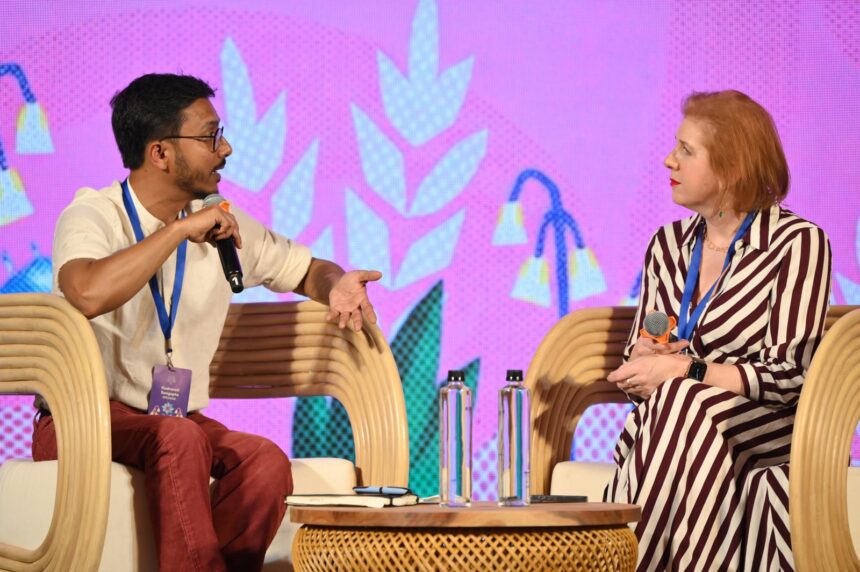
This highly engaging session opened with Rudraneil warmly welcoming Clare, who responded by saying ‘Dhanyavaad’ (‘Thank you’ in Hindi).
Rudraneil expressed a tinge of jealousy while reading her profile, since he had taken a lot of time to connect with the police and understand how they work, whereas Clare had already “been there, done that”. Clare quipped that maybe he was just lazy!
In reality, noted Rudraneil, detectives have a lot of clerical work, going through reams of data, and asked how Clare makes it exciting for readers.
“I bend the truth a bit,” confessed Clare. She gave an example of CCTV footage — in real life, the footage would be delivered to the detective, whereas in her stories, the detective goes to a petrol station to collect the footage, creating an opportunity for conversation and the build up of the story.
Rudraneil asked Clare about her book, I Let You Go, which is about grief and not police work — was this a conscious decision? Clare responded in the affirmative, adding that she puts people before plot. She shared that she touches upon grief a lot in her fiction; her son died in 2006, one of the reasons she started writing.
From police to writer
Clare narrated the story of how, when she was preparing for a promotion to Chief Inspector, her 360-degree assessment, brought out that she was positive and enthusiastic. Her husband was surprised, because, at home, she was not so positive. She would take the best bits of her outside and bring only leftovers home. Clare reflected on the pressures of being in the police and wanting to step back; however, she had also needed the money from the job.
Now – Work life balance
Clare confessed that work life balance was challenging even now; however she could decide when to take time off and be home. Responding to Rudraneil’s query on work-life balance during her time in the police force, Clare replied that she was bad at switching off; now she’s thinking of how to murder someone!
Moral insights as a police officer
Clare shared her insights from being in the police, that any of us is capable of doing terrible things under certain circumstances. She compared herself with a young woman from Oxford, who had grown up in a similar environment. When the woman’s father died, her relationship with her mother broke down and she took to heroin under the extreme circumstances.
Rudraneil recounted the story of a six-year-old girl in Delhi, who disappeared from her house and came back the next day. She told the police that a man had taken her but treated her well. The police closed the case. A similar incident happened with another girl later. The police investigated and found the man who was doing this. He had lost his daughter; this was his mechanism of coping with grief. The police prosecuted the man according to law.
“You can’t have a law and decide not to use it,” remarked Clare, wearing the police officer’s hat.
Yet, when she wears a writer’s hat, she finds herself humanising the criminal. She spoke of Hannibal Lecter in The Silence of the Lambs, whom she admires more than Jodie Foster because he loves classical music, is well read and charming.
Rudraneil remarked that police work now must be less exciting, because so much work is about going through phone recordings, CCTV and digital evidence compared to field work in earlier times.
Clare agreed, and revealed this is why she delves into the mind of the villain as well as the victim and brings out the human side of detectives.
The conversation shifted to the key characters from Clare’s crime series, Ffion and Leo, their avoidance of a relationship, and the time that Clare puts in to craft her characters’ personal lives. “A lot”, said Clare. “It stays in my mind every moment.” For example when she stepped out to buy lipstick, she kept thinking: what color would her character buy?
On this note, it was time to open the floor for audience questions.
Questions
- A fan of Agatha Christie referred to how her idea of crime fiction was to restore order to society and wondered if it is the same today. Clare responded in the affirmative, reiterating that the world is always chaotic and crime fiction gives us the sense of order.
- Do the cases she has solved bleed into her writing? “No” said Clare, adding that she would be terrified if that happened.
- What does Clare use to make a watertight plot? She does use a ‘murder wall’, string of photos, etc. to visualise it.
- The wittiest poser was reserved for the finale. A gentleman had lost five expensive bicycles in the UK; the police say they have no time. He wondered whether they were busy writing fiction. Clare responded by saying, “I apologise.”
Tick tock, the clock caught up with us, and Clare ensured we ended the session on a high, with a “stage selfie”!
Usha Ramaswamy
Usha is an IT professional who loves to read, vlog (Usha’s LENS) and travel. She is an amateur mobile photographer who shares her snaps on Instagram. Her philosophy is to make the most of life and relish every moment.