
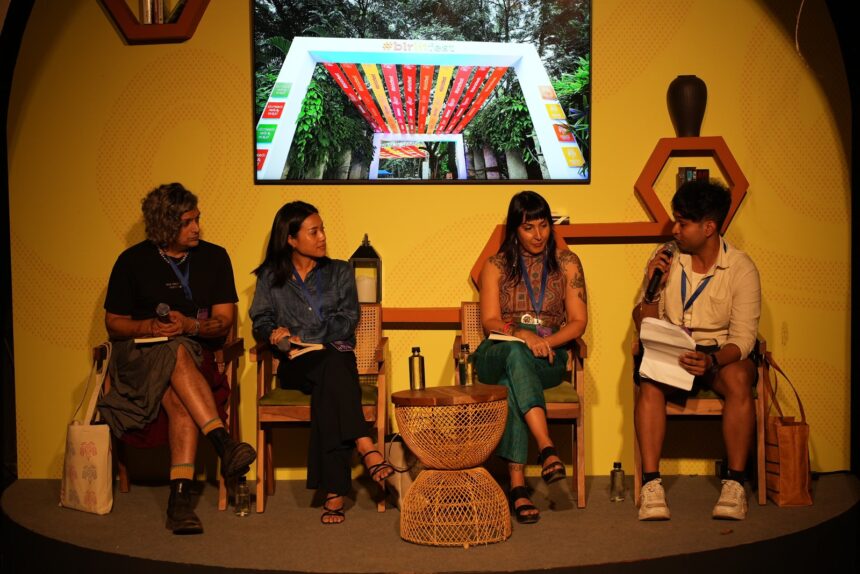
The session, “Not All Who Wander Are Lost: Exploring Identities,” featured a candid discussion with authors Kazim Ali, Rani Neutill, and Thammika Sangkeo moderated by Chaitanya Srivastava. The panellists openly explored their personal journeys and experiences concerning the shifting emotional, geographical, sexual, spiritual, and generational landscapes that have shaped their identities.
Chaitanya opened the session by challenging the traditional, fearful view of “wandering,” reframing it as a process of discovery and exploration crucial to the panellists’ personal stories, rather than an act of getting lost. Each panellist then introduced themselves by reading an excerpt from their work: Rani Neutill from her mother-daughter memoir; Thammika Sangkeo on a woman’s account of burnout, motherhood, and womanhood; and Kazim Ali on finding expression as a Gay Muslim man overcoming oppression.
The moderator prompted the panellist’s to discuss the first boundary each had to cross in their artistic and personal lives. Thammika identified this boundary as honesty, emphasizing that moving beyond self-deception was a vital and continuous process. Rani highlighted vulnerability, explaining that her desire to write her story in a raw, crude, and real way ultimately granted her complete freedom of expression, while Kazim offered a nuanced perspective, detailing how writing an autobiographical novel with fictionalized events allowed him to be more truthful than a memoir, as this approach gave him the freedom to blur the line between fiction and non-fiction, avoid ethical concerns, and even break the structural boundary of the novel itself by leaving the story, much like life, without a definitive closure.
Srivastava explored the fluidity of Kazim Ali’s work across poetry, prose, fiction, and non-fiction. Ali confessed to a discomfort with language, feeling it fails to encompass reality. This perpetual failure to capture experience leans him toward being a poet at heart, though he enjoys the freedom found in writing prose across various genres.
Rani Neutill then discussed her experience writing about generational trauma through her memoir, specifically addressing the silences around mental health in Bengali families. While she initially theorized about not letting her ancestry define her, she came to realize this was a trap. She embraced the messiness of being defined by her ancestry, finding liberation in writing about her mother’s passing—a process that contrasted with her earlier academic efforts to master scholarly prose.
Srivastava then posed a question to the panellists: Is identity a wound or a weapon? He further asked how does one balance revelation and holding back in the context of each one in their journey? The discussion on whether identity is a wound or a weapon produced nuanced perspectives from the panellists. Thammika took on the question by sharing a vivid somatic metaphor: a cut that is a wound, but if deep enough, the resulting splash of blood acts as a weapon, emphasizing the reactive nature of being deeply hurt. As a dancer, she finds the necessary balance between revealing and holding back through her body and feeling the experience somatically. Kazim Ali rejected the binary, instead describing the act of speaking about things previously unspoken—such as his identity as a Gay Muslim man—as a “healing bomb” for the self. This internal healing then becomes a weapon for others, inviting them to gain courage and join him in their own truths. Rani agreed with Kazim’s sentiment, stating that while mental illness is certainly a wound, the act is not so much about wielding a weapon, but about the liberation of uncovering the wound itself. She concluded that simply creating a space where such painful experiences can be openly spoken of is inherently healing.
Thammika addressed the topic of female burnout, attributing it to the cumulative weight of the unsexy, tedious micro-decisions women make daily, which often go unwritten or miswritten. She noted that many women hesitate to write their truth because it is deemed too “tedious” and not considered an art form publishers would embrace.
Kazim Ali responded to a prompt about rewriting one’s narrative by asserting that one’s identity is an accumulation of experiences. He stressed the artist’s responsibility to create the best work they can without glamorizing suffering.
The session concluded with the panellists reflecting on the profound question of what home truly means. Rani stated a strong disbelief in the very idea of a home, suggesting that her dogs served as the closest substitute. Thammika shared that she held a similar view until recently, but had come to define home as a feeling of safety—a sensation she primarily experiences when hugging her partner, emphasizing that a physical structure is not necessary. Kazim Ali offered the most succinct summary, concluding that home is simply where one feels loved, and where one can make a home for others.
The panel offered an invigorating conclusion on exploring identity through authentic personal stories and the artist’s responsibility to come home to the self in the most vulnerable and truthful way.
Disha Bhandari
Disha Bhandari is an Arts & wellness enthusiast, having spent over a decade in corporate leadership roles spanning across marketing and strategy. She is currently working as an art therapy practitioner curious about the working of the human mind, and how culture and nature impact things at large. She runs a company called Buoyant Living www.buoyantliving.com where she creates programmes for Individual growth & change in order to bring about a transformation in behaviour and action, which creates an impact on the environment at large. She loves reading, blogging and trekking, and lives in Bangalore.