
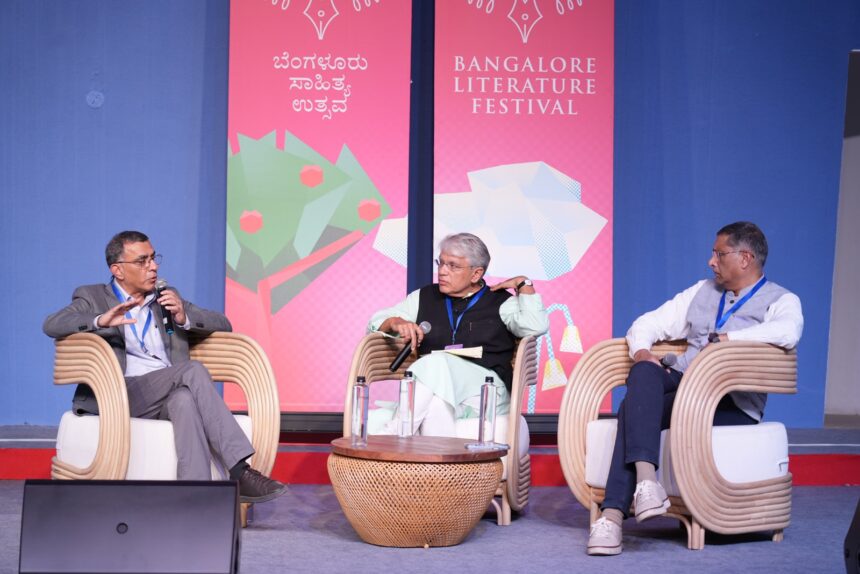
“Our approach is not a ‘to do list’, but a Hippocratic Oath of ‘do no harm’ and that is why we were talking earlier about the early achievements and why we should stop undermining them.” A line that pretty much summed up the tone and tenor of this exciting panel discussion on Devesh Kapur and Arvind Subramanian’s book One Sixth of Humanity, a major work examining India’s 75-year economic and political journey, blending economics and political science to explore India’s development path, policy choices, and unique democracy, often through public events and discussions.
Given the level of political discourse in swathes of online forums in this nation, this packed session guaranteed excitement and valuable insights considering it was a joint effort by a political pundit and a veteran economist. With some sound moderation that produced some hilarious moments from Manish Sabharwal and his tongue in cheek humour, this discussion stirred emotions, evoked questions and to say the least, entertained. Devesh’s incisive political understanding and Arvind’s years as an Indian economic policy maker regaled us with a mellifluous duet of erudition and intellect.
Manish sparked off the talk with broad strokes asking both of them at the back of a Tolstoy quote if the rich countries are alike or the poor ones and why? Arvind explained this by stating that it was our faculty to overdetermine failure rather than our success which made the poor countries look alike. And yet he added that the beauty and magic of India is the distinctiveness of both its successes and failures and the patterns and exceptions making it an exciting study. He cited the global outlook of some Indian states as the reason behind their success and yet that had been attained through means that were vastly disparate.
Pushing the dialogue a bit further Manish then asked them then if the pattern of failure in the BIMARU( acronym for Bihar, Madhya Pradesh, Rajasthan and UP) states was unique to them vis a vis the southern successes. Devesh agreed on the commonalities across the Hindi belt in human capital, law and order, governance and low agri yields, asserting that high agri yield was the only path to development.
Quoting Woody Allen’s famous quote on bisexual doubling the chances of finding a date, which led the audience to erupt in raucous laughter, Manish quizzed the guests on whether their work was on economics or politics. Arvind took up that torch refusing to be straightjacketed in that binary explaining ever so clearly how in the development of any nation the lines between economics and politics sometimes blur and that the book is an effort towards shedding light on these hazy lines and extracting meaning from them.
Manish pushed back stating that the question remained unanswered given that mass prosperity still remained elusive despite having mass democracy. Devesh averred that India was a precocious democracy and it was in fact that which forced successive governments to make choices which wouldn’t have been so in the absence of a welfare state. He backed it up by stating the incontestable data about primary education being achieved before the idea of universal adult franchise. He argued that unlike other nations India was unique because unlike the European nations, it wasn’t built on the idea of a single language or ethnicity and that had amazing consequences in forging a country with foundational principles of diversity and inclusion.
With a touch of humour Manish asked them on who could then take the blame for the failures amongst circumstance, choices and the democratic framework. Arvind attributed it to poor choices without a doubt and cited poor land reforms as the seed of all failures which stymied most reforms. He summarised with a line from his book“ if the price of democracy is the absence of revolution, the pricelessness of democracy is also the averting of social disorder” drawing generous applause.
This sparked off another round of queries from the sprightly host when he continued with his line to ask the guests if India reforms only when its back is to the wall and if the 1991 reforms were done only out of compulsion. Devesh lucidly explained how despite years of preparations by reformists it was the political opportunity that was missing and that the balance of payment crises truly paved the way for that to happen. Arvind expanded on China’s example to complete the thought by saying that it forced India to abandon the thought that reforms could be achieved by small economies only.
The discussion took a turn towards the softer aspects as Manish asked them about the surprises that sprung up during the course of their research. Arvind shed light on the growth story of many states being at par with the Chinese numbers while also shocking the audience with the revelation that the Indian fiscal deficit had only doubled each year. Devesh shed light on his shock and awe after having compiled data for more than half a century for state owned enterprises understanding how costly they had been. Quoting “ The sheer haemorrhaging by these enterprises had cost the country 1.5% – 2 % GDP every year” saw a hush falling in the audience as the numbers sank in. The absence of a sense of self correction almost closed the sense of despair that the answer had evoked. Tearing into the popular contention of the southern states fuelling the growth in the Hindi belt, Arvind contended that though it was true, it was in fact the western Indian states and Haryana which were bleeding the most.
Manish took it to the final laps when he assiduously questioned their contention that India was sliding into majoritarianism and illiberalism, attributing it to the cribbing of outgoing elites about the incoming ones while drawing generous applause from the audience. Devesh agreed humorously about the fallacy of a halcyon past but averred that the massive decline in levels of violence indicated a definite shift towards the positive while not denying institutions had weakened considerably in today’s date, citing the muzzling of free press and the concern amongst minorities as something for the nation to be worried about. Devesh capped it by quoting it was the first time in his three decade tenure as a teacher at Wharton that he had requests from minority parents to dissuade their wards to go back to India. A comment that swept a wand of silence over the audience grappling with the reality they faced.
The Q&A kicked off with a gentleman questioning the inability of the state to change course in the face of compelling data. Arvind answered that what was more surprising was our inability to build on the successes rather than dwell on failures.
Another question touched upon the futility of aligning the foreign policy with Donald Trump and its consequences which prompted the ever sprightly host to comment that “cultural explanations for poverty were at best the soft bigotry of low expectations and at their worst racism” as the audience erupted into peals of laughter. Devesh argued that in fact Trump had done India a favour since Indians didn’t change unless compelled to (kick to the hind side!) And that it had compelled us to change a lot of redundant policies. Arvind capped it by stating that the biggest driver of change was economic growth itself and placed his currency on the logic of economic federalism and competitiveness between states.
The final question from the audience questioned the veracity of the data the authors had relied upon in light of the recent downgrading of India’s rating on the statistical front. Devesh, agreeing to the concern, assured the member that numbers had been cross checked against various other sources as well before being taken up for conclusions in the book.
Rahul Rishi Kaul
Former private banker. Serial Entrepreneur. Photographer & Ad filmmaker. I run an independent content production house called The Yellow Picture. I’m a voracious reader and consumer of books and cinema. I hold a subtle flexible view on literary art but I’m opinionated on cinema. Love poetry and history with equal grace.