
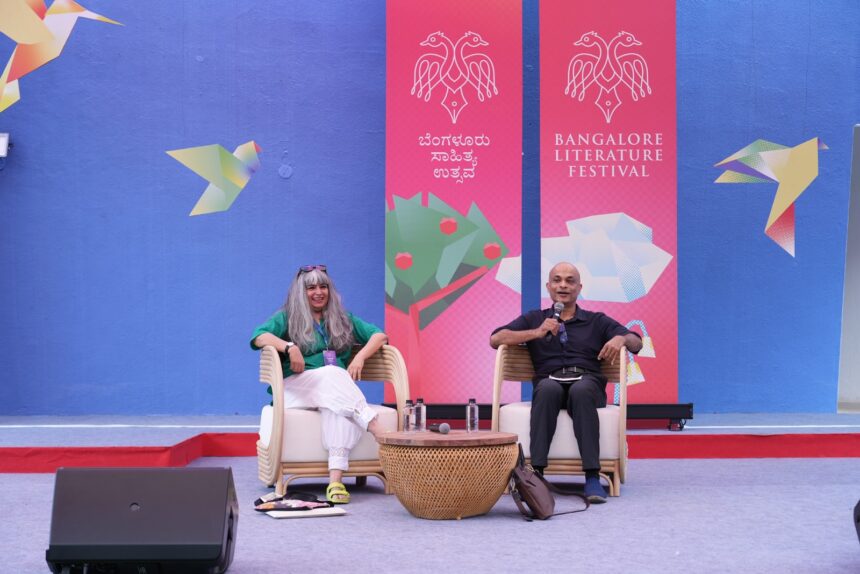
If you ever wanted a panel that sliced through morality, love, insecurity, and the architecture of relationships with wit and startling clarity, Arundathi Ghosh and Manu Joseph delivered it brutally honest, unexpectedly tender, and wildly funny in this session.
Manu opened with his trademark self-deprecating humour: “We Malayalis can barely find one person, and here we are discussing how to find many.” And with that, the conversation on polyamory and the myths, fears, and moralities around it took off.
Manu’s first direct and straight question was: “What do we look for when we’re looking for The One?”
Arundathi offered a simple but radical idea that we struggle primarily because we’re hunting for “The One,” i.e., a single person who must meet our encyclopaedic list of needs, wants, shoulds, and life guarantees. “If you stop looking for ‘the one’, you will find many,” she said.
Manu quipped: “Stop looking for bread, and you’ll find cake.” Arundathi countered: “Stop looking for bread that never existed.”
The audience laughed, but the message was unmistakable: Our romantic hierarchy that puts one relationship above all others is a cultural construct. And maybe not a helpful one.
On the topic of hierarchy, Manu added that the real question that one does not ask is “What does hierarchy mean in love?” Arundathi said the question she wishes people would rather ask is: “What does hierarchy in any relationship mean?” She said that we assume romantic–sexual love sits at the top of the hierarchy. But in real life, intimacy is fluid. Rings of closeness shift with life stages, needs, crises, and care.
Manu then moved on to another important emotion that does not get discussed often. He asked, “How do we cope with that horrible thing called jealousy?”
Arundathi reframed it beautifully: Jealousy isn’t about love. It’s about fear and loneliness. It’s the panic of believing that love is a spotlight with only one chair beneath it. But what if love was a whole meadow of chairs, cushions, moodas, green grass? Jealousy, she reminded us, shows up everywhere—between friends, siblings, colleagues, even the Federer fans. It’s not exclusive to romantic love. She gave a brilliant analogy of parent-child relationships. Do we imagine only one child for a parent? If not, and we do not question why parents have multiple children, a similar analogy should go for polyamorous relationships. Her hope is for a future where comparison shrinks, and compersion grows.
Joy in the joy of those we love.
Manu yet again wore his humour hat and joked, “Arundathi, I’ve heard that polyamory isn’t about sex… It’s about chores. That means I’d have to do chores in eight homes.” This resulted in loud laughter in the amphitheatre. Arundathi gently nudged everyone away from the numbers and also lightly pointed out where the number eight emerged from. She said that polyamory was composed of two words, poly and amory. We must focus on the “amory” part, which means the capacity to love. Not the count of partners.
She drew attention to how limited our language is. We say “just friends” for one of the deepest human bonds. Sex, on the other hand, we pedestalise and pathologise.
She reminded us that love is not an emotion. Love is action. Care is what love looks like when it gets to work.
On whether public figures need to add disclaimers, as it might negatively impact the younger generations, Arundathi was clear that young people don’t need her endorsement. The younger generations have always experimented and questioned. She learnt a lot from them. She shared two learnings, one of which made her very joyful and hopeful, while the other filled her with sadness. Knowing that they’re breaking boundaries just as fiercely as previous generations makes her happy and hopeful, while the fact that they aren’t able to trust their parents enough to be honest makes her sad. This means that our generation hasn’t created safe spaces for them to share who they are.
Manu asked about legality and the state’s role in intimate lives. Arundathi’s answer was both pragmatic and cautionary. She spoke of two truths she learnt from lawyers; One that we need state systems in an unequal world. But when the state enters the private realm, it legislates with rigidity. It cannot understand fluidity, nuance, or multiplicity. Law will ask for limits, clarity, boundaries, none of which relationships obey. And second, that the law eventually serves the powerful. She alluded to having examples of those who eventually end up in prison.
After this delightfully open discussion, a lot of hands among the audience were up, eager to ask their own questions. The first powerful audience question asked was “Poly in India has historically benefited men. What does it mean to be a poly woman?”
Arundathi didn’t shy away from confirming that indeed patriarchal power structures persist. But in polyamory, power can be redistributed more honestly, more consciously. Still, women do carry a greater risk and judgment. Being a poly woman means navigating patriarchy with multiplied scrutiny.
The other question from the audience was, “Isn’t Love Harder With So Many People?” On which, Arundathi’s answer was simple: Love is hard—whether with one person, two, or many. The core issue is power. In any relationship, we grant the other person the power to hurt us. We hope they won’t use it. Watch for red flags, she said, but remember that everyone’s thresholds are different.
One of the final questions was “How do you differentiate cheating in monogamy from exploring poly?” Arundathi summed it up in three words, Honesty. Transparency. Responsibility.
“And maybe that’s where the whole conversation lands: Not on numbers, not on labels, not on moralities created by unattractive men,” as Manu joked. But on how we treat each other, how we care, how we stay honest, how we build lives that honour our truths, even if they don’t fit the template we inherited.
Neha Agrawal
A former IT Engineer and now a practicing Counselling Psychologist since 2025. I have over 22 years of life and corporate experience, including contributions as a leader, consultant and trainer in education spaces, NGOs, DEI (Diversity, Equity, & Inclusion) and women’s empowerment. I have also co-authored a book ‘Periodwonderland’ – a graphic comic novel. I also occasionally write books for CBSE and blog for events like BLF. My other interests include traveling to the mountains and forests, teaching children, meeting people to understand them deeper, art and cultural spaces and reading.
Email: writetoneha@gmail.com | LinkedIn: agrawalneha | Instagram: one_conversation_at_a_time