
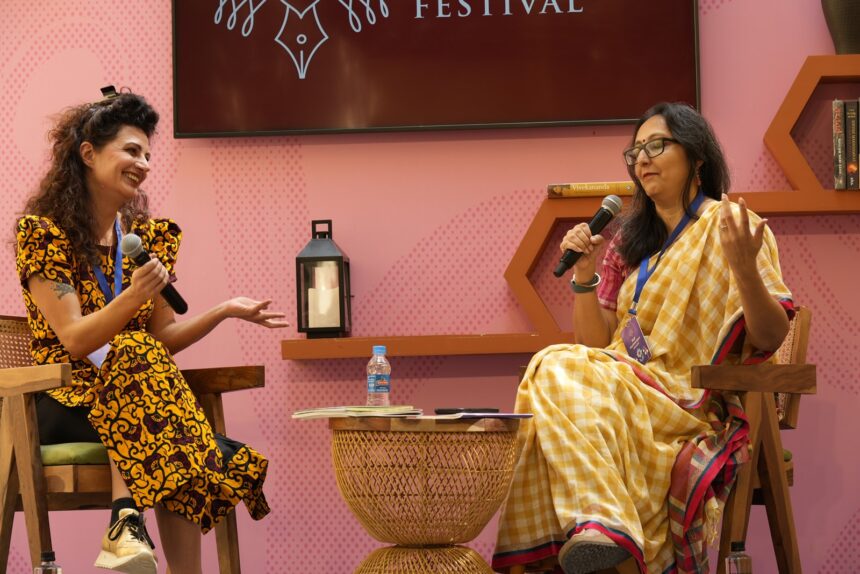
As someone who campaigns for the inclusion of graphic novels in the literary scene, this event became one of those larger-than-life events. I had to get the front seats!
Full disclosure: Like many of the head-scratching, bespectacled, hooded nerds, I had no clue who Miglė Anušauskaitė was. So, I ended up doing some digging before the event. That’s what I found:
Miglė Anušauskaitė is a comic book author and senior researcher at the Judaica Research Center. Born in Kaunas in 1988, she later lived in Pakruojis and Vilnius, where she studied, read, wrote, and eventually began to draw. She graduated from Vilnius University with a bachelor’s degree in journalism and a master’s degree in semiotics. The topics of the author’s work include literature (a comic column in ‘Šiaurės Atėnai’ since 2013), cinema (a column in kulturpolis.lt since 2014), and history (the book 10 litų, together with Gerda Jord, 2014, published by Aukso žuvys; in 2015, the book won the Patriots’ Prize). Her works have been exhibited in collective exhibitions in Italy, the Netherlands, and the Lithuanian National Art Gallery, as well as in a personal comic art exhibition in Klaipėda.
The session began with Miglė discussing the perennial stereotype of comics from the outset. People still view comics as an inferior art form. “I have many clients approach me and say, ‘Oh, can you do this in the comic? We want to attract young people,’ as if young people would automatically be attracted to anything with pictures,” she said. “It’s not like they will see this and they will lose their minds.”
Miglė highlighted the peculiarity surrounding comics’ place in the current landscape, where they are viewed as both shameful and a magic bullet for getting young people to read. She put comics in the same bracket as cinema. “But we don’t think that all cinema is bad, right? Of course, there is some bad cinema, and there is some good cinema. But somehow comics just remain in this weird space where they’re regarded as inferior,” she concluded.
The setting was much different thirty years ago when Miglė started reading comics after the Soviet occupation. At the time, comics were not really in Lithuania. Later, when she did her first comic with a colleague, most editors they approached said the same thing: Nobody buys comics!
After much headhunting, they did manage to find an editor. “It was a biography of two historical personalities, and it won some awards, and you know, then it became, kind of, more respected, and now more and more comics are being published,” she mentioned simply as if it was inevitable.
Then she recalled a story about her second comic on semiotics, which she wrote while studying semiotics, and the adult content it contained. The book was marked for readers over the age of eighteen, and like with most adult comics, it had a certain degree of counter-effect. Years after reading this comic, some of those kids came to her and asked why it was forbidden for kids at that time.
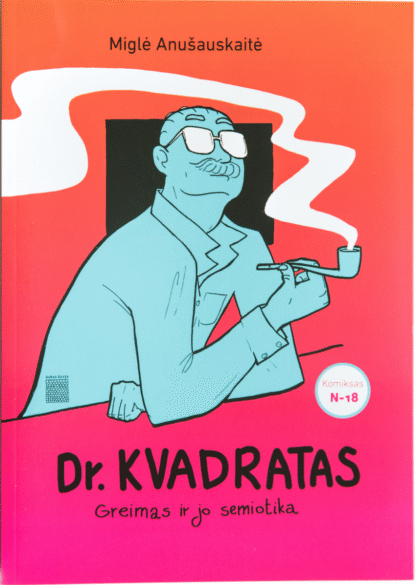
“Nowadays, we have a way richer comic culture, but still not as rich as I would like. It’s still regarded as an educational medium, not as a creation in itself. So you can, you know, sell an idea to a publisher for a comic about an important historical personality or something like that, but you can’t sell a comic about life and death,” she concluded.
For Miglė, reading comics is what keeps her sane. She mentions discovering people regularly who say they don’t find time to read because they feel too tired and stressed, to which she replies, “Maybe that’s why you’re tired and stressed.” She particularly finds paint books to be excellent therapy, which is consistent with the fact that she began drawing during boring university lectures. This subsequently led to much after-lecture banter and gossip over her drawings.
Like most cartoonists, Miglė started by posting her illustrations online. She was then asked to create free drawings for a magazine to gain exposure. “I was doing comics for a while,” she said, “but I started getting, like, some respect after I published a proper book with an ISBN. Then you can get some respect, but before that, it’s very much not so. So it’s sort of happened accidentally—comics for me, and I still read some comics, but off the read, you know, normal books.”
A lot of Miglė’s are about historical characters, like the ones shown above. These works are a result of her selective reading and her fondness for research. She doesn’t intend to provide the historical truth, as she doesn’t consider books to reflect the historical truth in its entirety. She gets inspired by the stories of the characters and periods, and then strives to provide her interpretation of a version that can be visually presented best in her books.
“I draw a lot of comics, from the 20s or something, and some histories are about women, and it’s nice and lovely—lovely dresses, lovely hairdos, beautiful. But when it’s men, it’s like, oh my God, it’s just suits. It’s suits and suits and suits. And all the suits are so similar. And they’ like, ‘Oh, okay, this lapel could be like more pointy, and this lapel could be a bit more like this,’ I’m like, there are so many suits, and I’m so sick of suits,” she emphasized, as indicated by the lack of suits in her comics.
Her comic book about India, “The First Lithuanian Travelers in India,” was published in 2022 and has since become one of her older works. She mentioned the strange feeling associated with an older work and all the insecurities that come with it.
“In this book, I mostly thought about people and how they would react, how they would talk, and how they would interact with their environment. And we also have a Lithuanian version. So, like, I was also thinking about Lithuanian readers, obviously, because that’s my public. And I thought about what would be interesting for them. And also the project organizers and editors were talking with me and saying what is important, what I missed, and stuff. And now coming back, it’s been a while, so you know, it’s so strange to be visiting your older work,” she added. “Like I came back to this book, and I thought, ‘Oh, it’s actually nice. I like those characters.’ I think they’re very nice. I think of the characters, and sometimes I’m ashamed. Like, I feel like, ‘Oh, I didn’t do a good enough job. Like, I should have done this differently and that differently.’ I mean, I could have done something differently, but I like the characters here.”
Antanas Poška, one of the first Lithuanian travelers in India, was her favorite character to work on in this book. She remembered researching about Poška and found one of his diaries. His writing was so lively and visual that it captivated the artist in Miglė. She felt like she could draw his writing as a whole.
The highlight of the entire session, and what fascinated me the most, was her take on rejection.
“Well, at the beginning, I didn’t deal with it very well,” confessed Miglė. “I was really sad and, you know, when we start, and you doubt your art, it’s like, ‘Oh, maybe I’m not a real artist.’ Like, now I really don’t care if I’m a real artist or not, you know. I can survive from what I do, so it must be real—that means I’m an artist, so, you know, come on. But with rejection… I think I talked with a friend back then. He was a researcher, and he was writing papers. And I asked him how he dealt with a rejection, and he said, ‘You just get used to it. Just get used to it and don’t pay any attention.’ And it’s true, actually. I mean, it’s not pleasant to get rejected, but it’s just a thing that happens. Now, I see my creative work like a sort of throwing dirt around and seeing where it sticks, you know. When you are out of ideas, it’s a bit like dirt, right? And then you’re like, ‘Oh, okay, so, no, probably not.’ And then you throw somewhere else, and then, ‘Oh, okay, that’s right.’ So, you know, it’s just… I think it’s just practice—practice to deal with rejection and nothing else.”
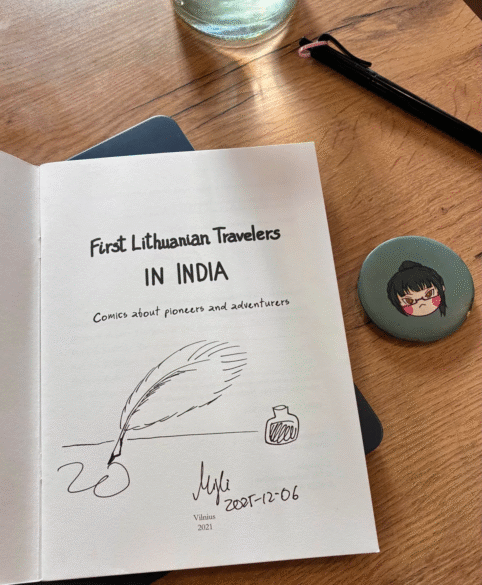
After the session, I met Miglė Anušauskaitė, and she drew a custom illustration on my request, along with her autograph. She is currently reading comics by Brect Evens…
This session was made possible thanks to the support of the Embassy of Lithuania in India.
Written by Maynk
I also write here.