
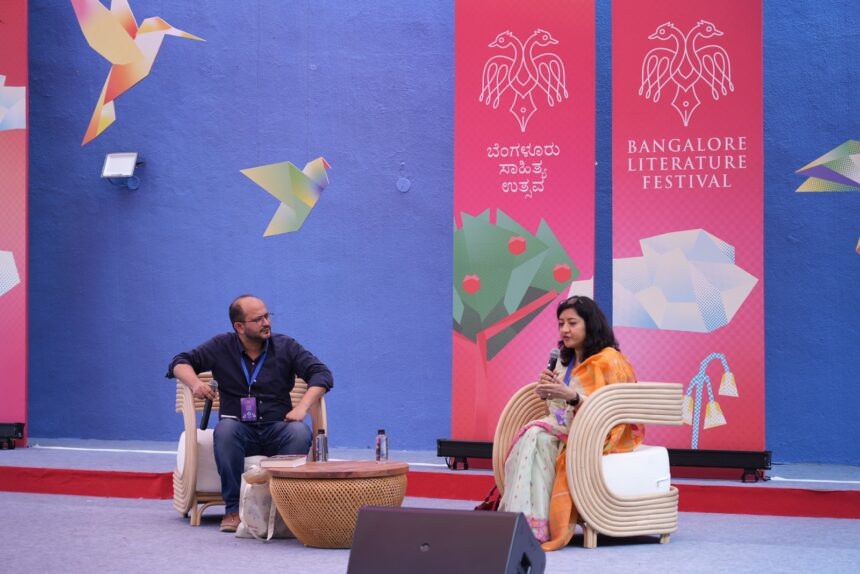
The post-lunch session brought together writer Tanuj Tanuj and journalist-author Ghazala Ghazala for a penetrating conversation on one of the most debated, misunderstood, and politically charged spaces in India: the Hindi Heartland.
Tanuj opened the conversation with the very pertinent question as to why should someone in Bengaluru or Chennai care about the Hindi Heartland? Why should someone living far from North India worry about what happens in the Hindi heartland?
Ghazala’s response was sharp and almost immediate. She recalled looking at an elaborate hotel menu where “Indian food” was essentially North Indian food, and “regional cuisine” was everything else, including an entire section on Karnataka. “Our cultural motifs, popular festivals, food habits, even the way the world perceives India – it all stems from the Hindi heartland,” she said.
Whether it’s Karwa Chauth made aspirational through Hindi films, or political power flowing through corridors that lead straight to Varanasi, the region shapes the narrative of the nation. Hindi Heartland could be tagged economically backward and socially troubled, but historically, culturally, and politically, it has been the crucible in which the idea of India was forged.
Ghazala described the heartland not just as a region, but as an ancient Indo-Gangetic civilizational zone, stretching from Rajasthan to Jharkhand. Interestingly, she argued that Haryana and Himachal Pradesh don’t belong to this construct—their histories evolved differently. Invaders, traders, and rulers gravitated towards this fertile plain where travel was easy, leading to enormous cultural assimilation. Even food traditions carry the imprint of shared geography—she pointed out how Rajasthani staple food ‘baati’ and Bihari ‘litti’ have so much similarity to each other.
Tanuj then asked about the contradiction in terms of the region often being spoken of as a cohesive cultural entity, yet also as a patchwork of diversity. He asked Ghazala’s views on which she thinks is it?
Ghazala didn’t hesitate: “Hindi is no one’s language.” She explained that Hindi as we know it was an administrative invention by the British, who sidelined hundreds of thriving languages by calling them “dialects.” Every district of Madhya Pradesh has its own language; tribal influences shaped linguistic identity; and Hindavi, a fluid blend of Hindi and Urdu, once served as the lingua franca before colonial restructuring split them apart.
When the British realised their primers referenced both Quranic and Puranic imagery, they deliberately divided them and created the Hindi–Urdu binary that remains politically potent even today.
Tanuj asked about the starkly different expressions of caste violence in Uttar Pradesh and Bihar which Ghazala linked to land. “Where there is no resistance, there is no violence,” she said.
In princely states like Madhya Pradesh and Rajasthan, social hierarchies were deeply internalised. But Uttar Pradesh and Bihar were never princely states and thus saw mass mobilisations of oppressed communities, especially during Congress-led anti-colonial movements. This is why Bihar saw massacres, while Uttar Pradesh witnessed more sporadic violence as the land reforms in Uttar Pradesh had managed to redistribute power to some degree. In places like Muzaffarnagar, even Dalits own land, changing the traditional equations of caste.
The conversation moved to one of the most cherished and contested ideas of North India: Ganga-Jamuni Tehzeeb. Ghazala traced it back to medieval empires, where Hindu and Muslim communities learned to coexist—not as a romantic ideal, but as an economic and political necessity. Small-scale industries, agriculture, craft networks, all required shared labour and mutual cooperation. The result? Centuries with almost no recorded communal riots.
Even language adapted to this spirit of harmony. “Aadab”, she reminded, was developed as a respectful greeting that neither community could object to.
Tanuj, who grew up in Muzaffarnagar, asked Ghazala about Other Backward Classes (OBC) politics and the shifting identities among Jat communities.
Here, Ghazala offered a fascinating socio-economic lens. Hindu and Muslim Jats share a long history, including mass conversions motivated by escape from taxes like jizya. When reservations expanded after the Mandal Commission, Hindu Jats were recognised as OBC but Muslim Jats were not—even though in South India, Muslim OBC categories exist. This imbalance fed simmering tensions that eventually spilled over into violence. Economic rivalry added fuel as the Muslim Jats often had Gulf incomes, while Hindu Jats did not. The result is today’s fractured landscape where the Hindu and Muslims are living in wary parallel.
When asked about the RSS’s influence in the region, Ghazala was unequivocal: “Deep.” She elaborated that the partition opened the door with the RSS’s extensive relief work for Hindu refugees earning them goodwill. They built schools, training institutes, and social networks. It was a soft power that laid a robust foundation. She noted that many Congress leaders at the time enabled this expansion, allowing the RSS a wide berth. Over time, this embedded Hindutva ideology into the everyday life of the heartland.
In the final audience Q&A, someone asked about alienation and anglicisation. Ghazala acknowledged the duality mentioning that English opens doors, but colonialism reshaped how Indians saw themselves, often in ways that fostered self-doubt and division.
Neha Agrawal
A former IT Engineer and now a practicing Counselling Psychologist since 2025. I have over 22 years of life and corporate experience, including contributions as a leader, consultant and trainer in education spaces, NGOs, DEI (Diversity, Equity, & Inclusion) and women’s empowerment. I have also co-authored a book ‘Periodwonderland’ – a graphic comic novel. I also occasionally write books for CBSE and blog for events like BLF. My other interests include traveling to the mountains and forests, teaching children, meeting people to understand them deeper, art and cultural spaces and reading.
Email: writetoneha@gmail.com | LinkedIn: agrawalneha | Instagram: one_conversation_at_a_time