
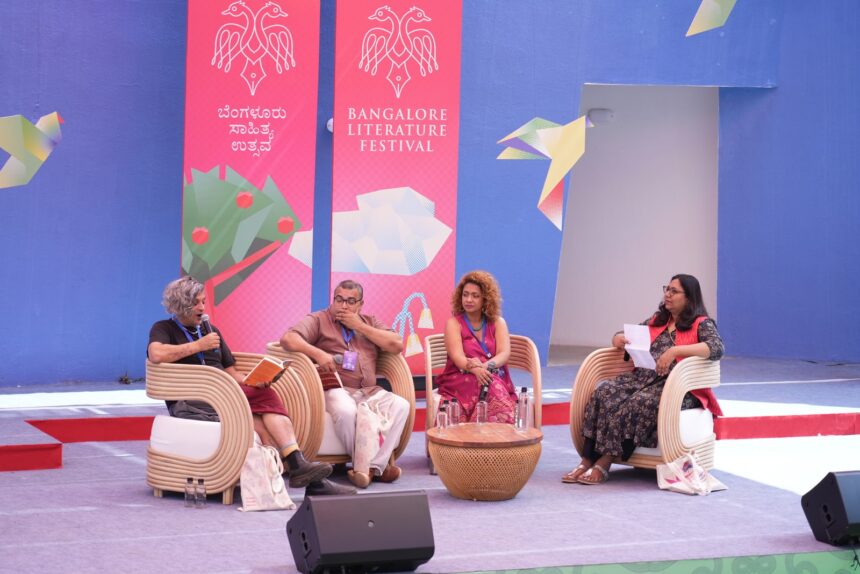
This session brought together three very different writers: Kazim Ali, a poet and novelist known for his lyrical and reflective work; Sabin Iqbal, a journalist and novelist who writes closely from people, places and social realities; and Ponnu Elizabeth Mathew, whose fiction grows from history, memory and personal questioning. The panel was moderated by Krupa Ge, a writer and journalist.
The session opened with a very obvious question: “Why do you write?”
Kazim said writing is a way for him to answer some of the most difficult questions independently, without the noise of the outside world.
Sabin, on the other hand, had a very different experience. As a journalist, he said he was surrounded by people whose lives demanded to be written about. On a personal front, writing helped him through difficult moments in his family life. He said he “resorted to writing” and created a world for himself.
Ponnu said she writes to understand the world inside her and the world outside. She sees happiness and suffering, beauty and pain sitting side by side, and writing becomes her way of holding those contradictions together. “I don’t get answers, but it’s my way to address these questions and understand them to a certain extent,” she said.
The speakers then read excerpts from their books. Ponnu read from her novel The Remnants of Rebellion. She read an excerpt which is inspired by her grandfather’s life and set against the backdrop of the Naxalbari movement. She explained that the story moves through two timelines: that of Eesho, the grandfather, and Aleyamma, the granddaughter. Sabin followed by reading from the last pages of his novel The Tales from Kabristan. Kazim read from his novel Indian Winter.
Since all three books deal with themes of grief and death, Krupa asked about the role of processing grief in their writing.
Ponnu said that the protagonist in her novel, Aleyamma, deals with the grief of losing her grandfather. Through the character, she processed her own grief too. “Writing Eesho was like letting my grandfathers live again on the page,” she said.
Sabin said writing is catharsis. Putting emotions on paper helps them move.
Kazim added, “All writing is an elegy. It comes after something has passed. Writing is one of the best ways to bring the dead back to life.”
The conversation then moved to the importance of travel in their works.
Kazim said there is something transformative about being in an unfamiliar place where you don’t belong.
Sabin spoke of Gulf migration, how displacement shapes identity, and how it is a major theme in his novel Shamal Days.
Ponnu said her novel takes readers across different places in Kerala and traces the history of the Syrian Christian community. Through places, legends and shifting time periods, her story becomes a journey through Kerala itself.
The discussion then shifted to religion and their relationship with it.
Ponnu said religion matters to her both personally and academically, and that the Syrian Christian community is a major theme in her novel.
Sabin pointed out that faith and religion are two very different things. Faith is deeply personal and cannot be written about easily, but religion is full of material for stories. His upcoming book also deals with conversion.
Kazim had a more philosophical answer. He said he is unsure where he stands now. Born Muslim and having studied yoga, he has experienced many approaches to spiritual life. He said that the more he tried to write about religion, the less he understood it, because it fixed his ideas too quickly. He compared religion to the banks of a river and God to the water. “If we stay on the banks, we only watch. To truly understand, we must step into the water, even if it means learning to face the fear of drowning,” he said.
As the discussion wrapped up, the audience was left with a sense of how distinct the speakers’ journeys were, and yet how closely their ideas aligned. Kazim spoke from a place of quiet searching, Sabin from lived experience and community, and Ponnu from memory and emotion. Together, they reminded us that stories come from many directions, but they all try to make sense of the world and our place in it. It was a calm, honest conversation, the kind that stays with you for longer than you expect.