
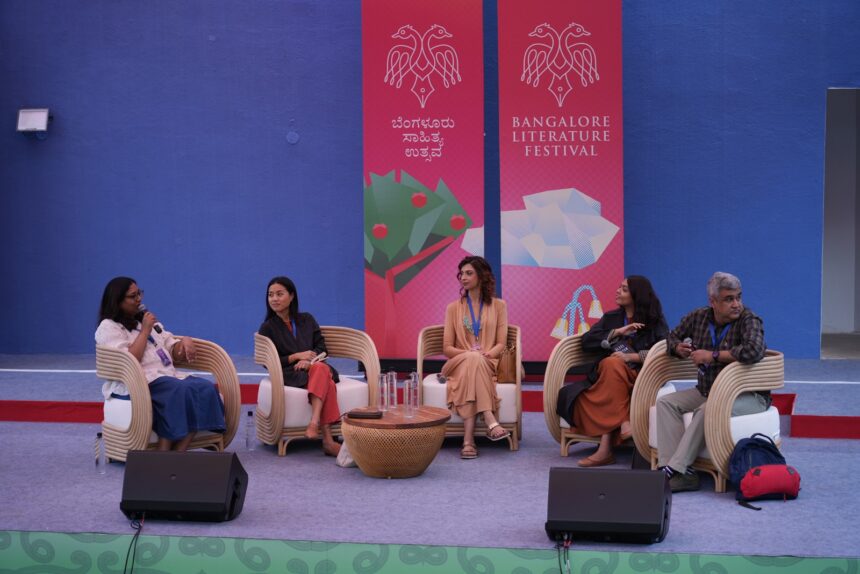
The session brought together four authors whose recent works explore the layered, intimate and often complicated relationships between mothers and daughters. On the panel were Krupa Ge for her book Burns Boy, Thammika Songkaeo for Stamford Hospital, Aishwarya Jha for Scent of Fallen Stars and Sonali Prasad for Glass Bottom. The session was moderated by Karthik Venkatesh.
From the opening question “Did the theme choose you?” discussion moved towards the emotional and creative forces that shape stories about family. What stood out was the honesty with which each writer described her relationship with the theme.
Krupa Ge said her inspiration came from her mother and called the story in Burns Boy “mystical”. There was a sense that the narrative lived inside her long before it reached the page. Aishwarya Jha, meanwhile, said she began writing a love story and unexpectedly found herself drawn into the terrain of parents and daughters. Her comment “The story chose me” was a reminder that some stories reveal themselves only when the writer is ready.
Thammika Songkaeo drew from a real event involving a mother, who used a hospital as childcare. Stamford Hospital deals with loneliness, existential dissatisfaction, failed intimacy, and the draining experience of balancing motherhood with personal ambition. It also shows how women often bear multiple stories at once: their own, their mothers’, and those society expects of them.
Sonali Prasad described her characters as someone who “lives inside a vessel of story”. In Glass Bottom, the sea becomes a metaphor for instability, longing and dislocation. Her insights on belonging, especially how even a single movie dialogue can define a character’s understanding of home, brought an intensity to the conversation.
One of the most compelling sections of the session was on rage. Each author approached it differently.
Thammika called rage an “amazing female characteristic” and a data point for the violations women endure. Her portrayal is intellectual and reflective. Krupa examined rage as both a happening and a performance, showing how her characters enact and contain it. Together, their insights suggested that rage in literature is not only emotion but also an evidence of injustice, resistance and self-discovery.
Aishwarya Jha then spoke about longing and loss in Scent of Fallen Stars. She explained that love, longing and loss often overlap, especially in families where silence, distance or broken and forgotten connections shape relationships. Her reflections on father–daughter and mother–daughter dynamics emphasised that families do not need to look “ideal” to be whole. Literature, she said, can challenge the myth that every family needs to fit the same template.
The conversation also moved towards how women navigate a world undergoing rightward shifts.
Krupa described being a witness as a powerful tool. When women are able to speak, they reclaim control. Thammika pointed out that women are being listened to more today, even if those in power do not always grant them freedom. She urged that as long as women have choices, they must choose wisely.
Aishwarya stressed the need to create female characters with true agency. She challenged stereotypes around “liberated women”, reminding the audience that liberation appears in many forms and does not limit strength or complexity. Sonali added that in every revolution, silent or visible, women have always found ways to hold space and reshape their worlds.
This session stood out because the four writers did not romanticise the mother–daughter relationship. Instead, they treated it as something evolving, imperfect and deeply human. The strongest threads running through the discussion were agency, inheritance and emotional honesty.
The authors approached their themes with restraint rather than sentimentality, which made their insights more powerful. There was also a refreshing readiness to talk about difficult emotions such as rage, longing, loss, displacement. These were not presented as dramatic plot devices but as lived experiences that establish both characters and writers.
As a listener, what struck everyone the most was how each book explores the unseen work women do: holding memory, absorbing generational pain, creating meaning from broken relationships and still choosing love in different forms. The session offered not only a window into the books but also into the emotional labour behind writing them.
Dr. Chhavi Gandhi
Dr. Chhavi Gandhi is a doctor turned author who documents books, culture and everyday stories. She writes about how literature shapes community life and personal identity. Her work blends clarity with warmth, grounded observation and a deep appreciation for storytelling.