
"Myth" comes from the Greek word "mythos," meaning a story that shapes moral codes and explores the human condition. Born through oral traditions, symbolism, and collective belief, myths quietly slip into our everyday lives—especially into what we eat, how we move, and how we measure health.
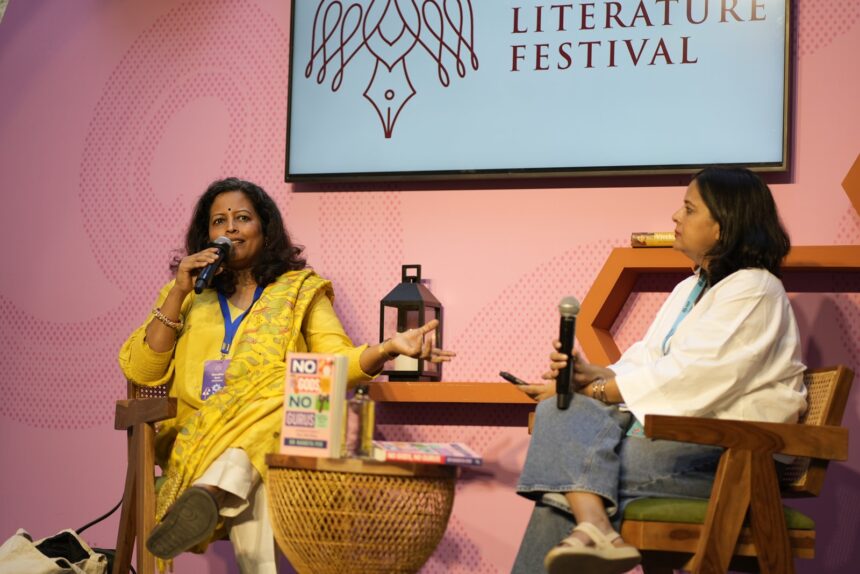
At No Gods, No Guru, these invisible beliefs were gently pulled apart during a powerful and refreshingly honest conversation between Shrabonti Bagchi and nutrition communicator Nandita Iyer around her book No Gods, No Gurus. “If you have basic knowledge, you cannot be fooled—so that makes you radical,” Nandita said with a smile, before playfully admitting how people even took her sarcasm as sacred advice, forcing her to remind them repeatedly not to believe anything without research.
With an MBBS degree, a fellowship in nutrition, and a diploma in mental health from NIMHANS, she spoke not as a guru but as someone deeply invested in questioning the very idea of one. Her work revolves around one simple truth—that nutrition is personal, and just because something works for someone else does not mean it will work for you. Yet in today’s fast-paced world, anyone advocating balance and sustainability is often labelled radical, while extremes are celebrated, and everything that once brought joy to our plates—dairy, gluten, fibre is suddenly seen as the enemy. She questioned what it even means to live longer if living itself is stripped of pleasure and warned against turning one single food into a villain or crowning another as a superfood, because no one ingredient has the power to make or break a body on its own.
As the conversation moved toward Indian food myths, laughter filled the room when she spoke about how even something as basic as drinking water has been overcomplicated, from warnings about standing and drinking to absurd ideas about it going straight to the knees, when in reality, she said, one should simply drink it however they like as long as they don’t choke. The rigid rules around not mixing foods, especially dairy, were also challenged, reminding everyone that many of these beliefs lack scientific backing, yet continue to survive because of the comforting argument that people were “fine” decades ago—overlooking the fact that life expectancy back then rarely crossed forty, while today it stretches beyond seventy largely because of evolving medical science.
When asked about protein consumption in India, she pointed out how our plates are dominated by carbohydrates, with aloo standing tall as the national staple, and how even meat-eaters often barely meet their protein needs, with one kilogram of chicken feeding entire families, unlike in countries where protein is central to daily meals. “Muscle is the new currency,” she said, highlighting how strength now defines long-term health. For those living on protein shakes and capsules, she clarified ‘Supplements are called supplements because they can never replace natural food,’ and stressed the dangers of self-prescribing anything without proper testing.
The conversation then shifted to our obsession with quantifying health, where smartwatches track every heartbeat, every step, and every fluctuation, often increasing anxiety rather than reducing it. She spoke about white-collar hypertension, how simply being in a medical setting can raise blood pressure, and compared it to how repeatedly checking your heart rate can actually make it race faster. While tracking basic metrics like blood pressure is essential, outsourcing every signal of the body to a digital device turns these gadgets into silent bosses, slowly disconnecting people from their own physical awareness.
And finally, the myth that gave this session its quiet headline—the famous 10,000 steps. Originating from a Japanese marketing idea called Manpo, where the character for 10,000 resembles a walking figure, it became a global gold standard not because of science, but because of branding, while in reality even 7,000 steps are more than enough for most bodies. The real message, she reminded everyone, is not to follow advice blindly but to ask why it applies to you in the first place.
As questions poured in about vitamin D deficiency and cholesterol, she explained how modern indoor lifestyles, work-from-home cultures, and limited sun exposure—especially among women—have made these deficiencies very real today. On trends like intermittent fasting and processed sugar, she invited everyone to turn to No Gods, No Gurus, gently hinting at how fruits are not equal to refined sugar, how aggressive fasting can affect mood, and how sustainability always outweighs extremes. By the time the session ended, it was clear that this conversation was never just about food, steps, or numbers—it was about unlearning, about thinking critically in a world desperate for shortcuts, and about realizing that health has no single god, no ultimate rule, and no unquestioned guru.
Chimee Zangmu Lepcha
Chimee Zangmu Lepcha is currently pursuing her third-year degree in BA Political Science and Communicative English at St. Joseph's University. She comes from Sikkim, the cheerful ‘brother’ to India’s seven sisters, a place that has shaped her love for stories, cultures, and quite the strength of community. She hopes to bridge differences, celebrate diversity, and spark conversations that bring people a little closer together. And if you’re ever looking for her, just follow the dogs.