
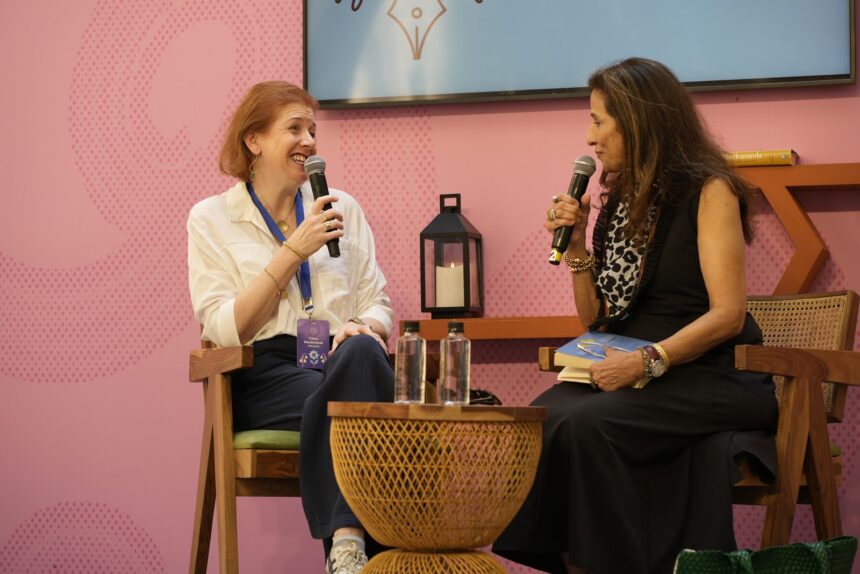
It was a Sunday morning, Day 2 of the 14th edition of the Bangalore Literature Festival. Clare expressed joy being in the Bangalore air, amidst the Bangalore people.
The conversation was to be a focus on Clare’s book about navigating grief. The tone soon shifted to a more serious one, with Shobhaa saying that she had read the book, absorbed it, felt it and cried. Clare remarked that no one is spared grief and no one can tell you how to grieve.
Motivation for the switch from crime to grief
Clare’s son died in 2006, about 19 years ago. Those circumstances and her journey through grief prompted her to write the book.
Clare read a chapter from the book to an audience that listened with rapt attention.
Cultural differences in grieving
There are generational differences in the way we grieve, explained Clare. “My generation grieves more openly than the previous generation”. She also spoke of how grief varies between countries. The Spanish, she observed, do not need any manual on grieving because they grieve openly. The English and Germans do not talk about death. Indians are open with sadness and honour the dead. Shobhaa added that in India, different states and castes grieve differently; albeit these differences, Indians believe in the ‘karmic’ cycle.
Clare reflected that in the UK, people find it difficult to talk about death. The English talk to children about birth but not what happens when we die. This also prompted Clare to write the book.
The story of death and grief
Clare’s son, Alex, one of her twins, died of meningitis when he was 3 weeks old. Clare recollected an incident which inspired the name of the book. About 4-5 weeks after Alex’s passing, a woman came to Clare’s door with a bunch of daffodils. She had lost a child many years ago. The woman told Clare, “It won’t always hurt like this”. Clare felt very angry to hear this, and thought that the woman could not have loved her child much, if she had gotten over the grief.
14 years later, Clare forgot the anniversary of her son’s death for the first time. Initially she felt guilty, then remembered the woman who gave her daffodils and mentally apologised to her. When she tweeted about it and the tweet went viral, Clare realised, “I need to write about this”.
Grief is personal
Shobaa asked, “Do you get impatient with people who expect you to be an expert on grief?”. Clare responded that grief is entirely personal. You grieve for different people in different ways. This is not a How-to book, it is a book of hope, one that shows the brutal honesty about grief and also that there are blue skies ahead.
Replying to Shobaa’s question on how men versus women grieve, Clare said that society expects men to be strong, hence they may not demonstrate grief. However, men do need to talk more about it and express their feelings.
It was now time for the audience to weigh in and ask Clare their questions.
Questions from the audience
- Which is the best way to talk to someone who is grieving, without hurting them?
Clare stated that the simplest way is to just ask, “How are you feeling today?”. Then suggest a way in which you can help, and ask if they are ok with it. Avoid an open ended question such as , “How can I help?”, because it puts the onus on them to think. - Did Clare feel guilty when she forgot her son’s anniversary? “Guilt and grief are twins”, responded Clare. It takes a long time to reconcile and come out of guilt.
- How did she cope with the child who survived? Clare spoke about her twin son’s ‘cellular memory’ of his brother. She also gave birth to another set of twins a year later. Now, they continue to talk about Alex in the family, as though he is still present.
- Do you wish you had this book to read when you were going through your loss? “Absolutely”, said Clare, adding that, back then, she had only books written by psycho analysts, whereas what she really needed was honest conversation between herself and another grieving person.
- Are there really 7 stages of grief? Asked one attendee, referring to a friend’s son who was not able to get over his father’s passing away a year ago. Clare replied that each person has to find what works for them, and reflected that you do not get over grief, you get through it.
The audience had a lot to absorb and contemplate. The packed Sunday morning session ended on this reflective note.
Usha Ramaswamy
Usha is an IT professional who loves to read, vlog (Usha’s LENS) and travel. She is an amateur mobile photographer who shares her snaps on Instagram. Her philosophy is to make the most of life and relish every moment.