
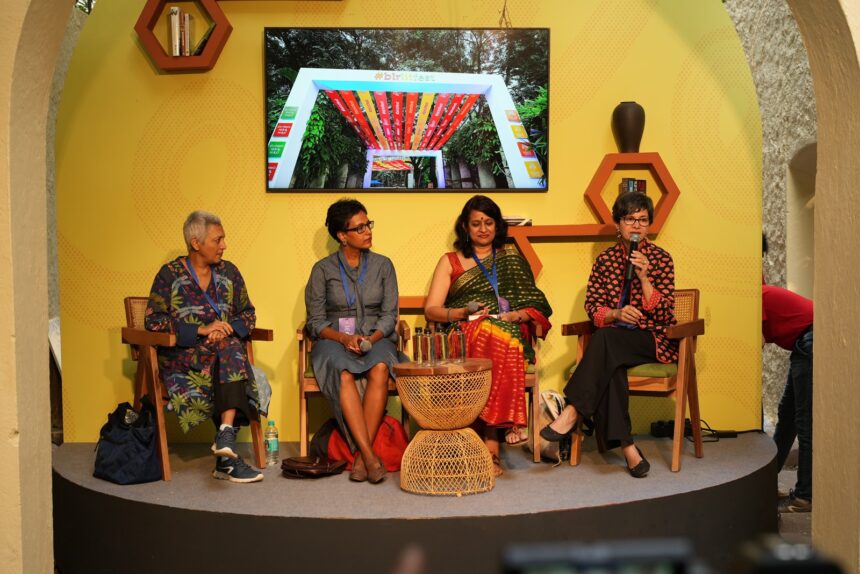
There is something comforting about watching a room full of people pause their lives for the sake of stories. The session titled Long Live Short Story, moderated by Jahnavi Barua, brought together three writers who approach the form in entirely different ways, yet they all carry the same quiet loyalty to the short story. There was no attempt to elevate it or defend it. Instead, the hour unfolded like a conversation among people who simply love what they do and have lived long enough with their words to understand what the form demands.
Aruna began by saying something that stuck with me . A story is a story. It does everything a novel does and it is not very different. And as she spoke about how most stories start with the ghost of an idea, the kind that wanders at the edges of your mind until you finally pay attention to it, she drifted into themes of ageing and facing one’s own mortality and the way society changes so quietly that we often fail to notice what we are losing or holding on to.
She joked about how many of our lives are shaped by the fear of what the neighbours might say and how this fear sometimes reveals more about human attachment to material things than we like to admit. In her steady voice, she reminded us that whatever a writer wants to say can be said through both the novel and the short story because form is not a boundary. It is simply a container for the truth one is trying to hold.
Amita followed with a candid remark that brought a small wave of laughter. She called herself a failed novelist, a work in progress forever, and yet she also said that the short form has been the most healing space for her. The short story gives her the freedom to explore multiple setups without the expectation to stretch them into a novel. It helped her focus on causality, on how one moment leads into another, because many stories fail at that essential movement from A to B even before they fail at emotion.
She spoke about the sense of achievement of finishing one story and how that sense of completion can sometimes sustain a writer through the long and wandering phases of doubt. Listening to her, I understood how the short story allows a kind of clarity that nothing else does, and how satisfying it must be to reach the last line knowing it is exactly where the story wanted to stop.
Ameena stepped in with her gentle humour and sharp clarity, confessing that she is an unfaithful short story writer because she moves between forms, but she also believes the short story is far more difficult than people assume. Every sentence matters. Every pause matters. Even punctuation becomes an instrument of meaning. She talked about a think tank in Sri Lanka publishing the stories of displaced wives and how those voices stayed with her long after she first encountered them.
When asked where she finds her material, she smiled and said that she is a notorious eavesdropper, and that material is constantly around her if she pays attention. “If a fragment of a story stays with you and comes back to you”, she said, “then it deserves to be pursued”. She added that once a theme becomes clear, discipline follows automatically, and she ended with a line that is quintessentially her. I do not want to do the easy thing.
The discussion slowly became a reflection on the process behind the scenes. Aruna talked about creating a character with only a few lines because the short story relies on precision. Amita explained how she must plot before she writes, because without structure she risks losing the momentum of the idea. She joked that a notebook is a terrible idea for someone like her because stories rarely arrive in sequence. Ameena returned once again to the idea of attentive listening. When some part of a story stays with you and comes back, it should be pursued.
What tied the session together was the way all three writers kept returning to the idea that the short story is not a constrained form but a form that demands honesty, precision and an almost fearless willingness to trust the reader.
The panel was diverse in every possible way, yet their opinions circled around the same truth, that the short story carries a kind of clarity that does not depend on length but on intention. They spoke about experimenting with ideas before settling on the one that asks to be written, about reading their work aloud, about the stories that arrive quietly from the world around them, and about the small joy of catching the exact line that reveals what the story had been waiting to say.
What I carried out of the session was a renewed respect for the short story and for the writers who choose to live with its demands. For an hour, three women showed us that stories do not need to be long to be powerful, that ideas do not need to stretch endlessly to feel complete, and that sometimes the most meaningful narratives are the ones that occupy very little space on the page but stay for a long time in the mind. And somewhere between their laughter, their honesty and their reflections, the title of the session made perfect sense. Long live the short story indeed.
Sharmila Giduthuri
Sharmila works in the automotive domain as a Senior Research Engineer at Mercedes Research and Development. She has been an active member of several non-profit organisations since 2019. She is currently writing her first book and also works as a freelance graphic designer.