
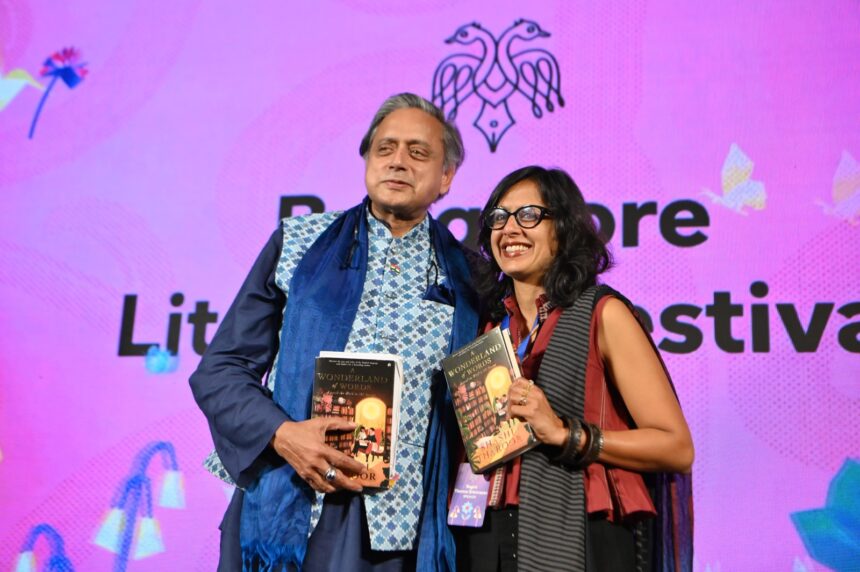
If there is anything that can keep people in Bengaluru at the Lit Fest at 7 PM on a Saturday evening, despite the traffic they have to brace afterwards, it is a session by Shashi Tharoor.
With an audience of more than three hundred people, including many standing and others who arrived two hours earlier just to secure a seat, the session felt like another one of Tharoor’s master classes. The crowd was ready to listen, laugh and probably learn a new word or two by browsing the dictionary on their way home.
The icing on the cake was the presence of Ragini Tharoor, his favourite and only niece, as the moderator. Her questions brought a rare personal touch to the session, beginning with the revelation that Tharoor is the annoying uncle who flaunts his English skills on the family WhatsApp group.
The conversation opened on a humorous note. Ragini spoke about how she expected someone at the festival to carry a remnant of the past, considering that the event was being held inside a former jail. She used this to introduce her question about how words carry their own histories. Tharoor responded, “words trail along history with them”, and went on to explain how words like loot and shampoo entered the English dictionary through the imperial encounters with India.
When Ragini asked how his writing process actually works, considering that he is a polyglot, Tharoor replied that the language you think in becomes the vehicle of expression. For him, English is the language of ideas, even though he grew up around many languages.
When she playfully asked which language he would want to work on next, he spoke about how Sahitya Malayalam is very different from the Malayalam spoken on the streets of his home state. The literary form can feel distant from the spoken one, yet both are valid expressions of cultural memory.
Ragini added her personal touch by asking about his parents. She spoke of how they played a word guessing game as a family long before any internet version existed, and how her grandmother was an enthusiastic fan of the game, Scrabble. Tharoor responded with a smile and said that there should be no more personal questions and only the other stuff.
When it was time to read from his new book, he chose the chapter on literary insults, something that seemed very much in line with Tharoor’s style. He quoted writers from Virginia Woolf to Shakespeare and did not leave any caveat for interpretation. For a moment, it felt like sitting in a class where words had their own personalities.
The next question moved to the judgement people pass based on accent and dialect. Tharoor explained how English is a completely irrational language. He gave examples like rough, bough and laugh to show how the same letters refuse to behave the same way. He mentioned how George Bernard Shaw once joked that the word fish could be spelled as G-H-O-T-I. His point was that English often tests memory more than reasoning, yet people are judged for getting it wrong.
The discussion then organically moved to the role of technology in shaping language. Autocorrect, he said, creates its own chaos. He joked about a colleague named Sommerens whose name his phone repeatedly changed to Somnolence. Even his own tweets have suffered from enthusiastic autocorrect interventions.
A question about artificial intelligence brought more laughter. He said chat based tools often prefer short sentences and dramatic pauses but they struggle with emotional nuances.
“Language is not only structure but also rhythm, memory and feeling, and that is difficult to recreate.”
Ragini then asked about untranslatable words. Tharoor spoke of Malayalam words that capture a feeling rather than an action, and how some emotions do not travel neatly across languages. He mentioned the Danish word hygge and the Russian word toska, both of which capture moods that English can only circle around, not fully contain.
The session ended with a reflection on how English continues to grow. Words like rizz and rage bait now make it to dictionaries because of the internet culture. Tharoor remarked that “the absence of an official guardian of English is what keeps the language alive. It adapts, absorbs and evolves with the world that speaks it.”
The session was a reminder that language carries history, humour and humanity in equal measure. In Shashi Tharoor’s hands, even ordinary words seem to wake up with new stories.
Sharmila Giduthuri
Sharmila works in the automotive domain as a Senior Research Engineer at Mercedes Research and Development. She has been an active member of several non profit organisations since 2019. She is currently writing her first book and also works as a freelance graphic designer.