
The wind was not on his side that day. Gourav was running(quite literally) through the streets of a city he barely knew, chasing a man he believed to be “Dronacharya to my Ekalavya”. It was his only chance to tell George R.R.Martin that he had written what he hoped was the Indian version of Game of Thrones. After running a distance equal to five Freedom Parks, he finally caught up, placed a hand on Martin’s shoulder, breathless and ready to impress. But all he managed to blurt out was, “Sir, you are everything.” It was a romantic scene straight out of a Meg Ryan movie.
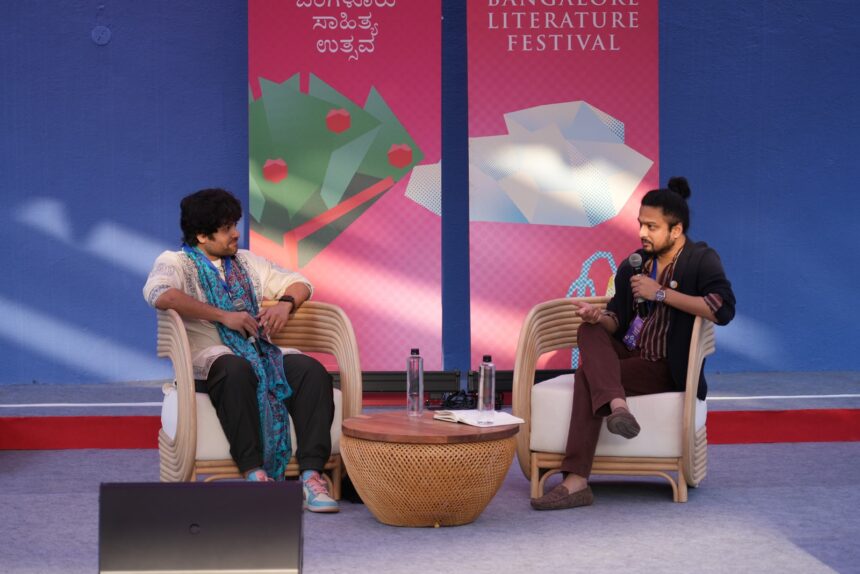
That mix of intensity, self-awareness and chaos set the tone for “Counting Electric Sheep: When Fiction Speculates”, a lively and engaging session featuring Gourav Mohanty in conversation with Sayantan Ghosh at the first day of Bangalore Literature Fest. Borrowing its title from Philip K. Dick’s “Do Androids dream of Electric Sheep?”, the conversation revolved around science fiction, AI and humans navigating this change. It delivered all that, without ever becoming heavy!
Gourav Mohanty is a lawyer by profession, and perhaps that explains his instinct to see the world in shades rather than binaries. “Being a lawyer, I have defended both sides and found that nothing is black and white but 50 shades of grey” he joked. The author of Sons of Darkness and Dance of Shadows, he is articulate, witty, and visibly comfortable questioning everything which doesn’t sit right with him. Sayantan Ghosh, the moderator for the session is also an author and an editorial director. He steered the conversation effortlessly.
The session opened with a question on how Gourav views dystopian societies as a writer working within fantasy and mythology. He responded by calling science fiction writers “soothsayers.” Not everything they imagined came true. There are no flying cars. But their deeper anxieties did. Gourav spoke about empathy as something curated rather than cultivated, and about how thin the line has become between the artificial and the real. In many ways, he said, we already live inside the imagination of science fiction writers from the 1950s. What makes it unsettling is that none of them imagined a happy world.
He shifted the conversation to how technology is shaping our creative choices. Outside India, even the suspicion of an AI-generated book is frowned upon, while here many openly embrace it. Gourav said this acceptance worries him because it replaces human creativity. Sayantan added that our reliance on AI may simply come from its accessibility. Gourav agreed but warned that personal use is fine only until AI begins to stand in for real creative work. When the artificial replaces lived experience, the dystopia is already here. Technology, he said, is useful only until it stops being a servant.
After the long detour into technology and dystopia, Sayantan brought the discussion back to Gourav’s personal choices and asked why he began with the Mahabharata. Gourav traced it to the stories his grandmother passed down, almost like heirlooms, and to the many versions of the epic that exist across the country. His introduction to Game of Thrones only deepened that curiosity. And when he could not find the kind of Indian fantasy he wanted to read, he remembered Toni Morrison’s line: “If the book you want to read has not been written, then it is your duty to write it.” So he wrote it.
While talking about the many versions of the same story, Gourav noted how some writers cling to one version and dismiss the rest. He feels myths are not carved in stone but shaped like clay, always shifting. When we insist that only one telling is right, we erase the others, even though none of us knows what the original truly was. In that uncertainty, he says, empathy becomes our only guide because it is the one thing that makes us human.
When the conversation moved to world building, Gourav admitted that this is where many Indian epic fantasies fall short. He joked that while reading Game of Thrones, he knew the map of Westeros better than the districts of Odisha, where he has lived most of his life. That, he said, is the power of good fiction. A story does not just give you characters, it gives you a world that feels alive. In his own books, he tries to give every place its own texture and temperament.
Then the conversation shifted to the struggle of getting the book published, a phase Gourav admits was anything but smooth. “It’s easier to convince a judge to grant bail than to convince a publisher to take on an epic fantasy,” he joked. Rejections piled up, and he even considered hybrid publishing. He wrote to readers outside India, hoping to build interest slowly. And when publishers finally responded, many asked him to split the book into two. “Thick books are body shamed in India,” he joked. He added that the problem is not a lack of epic fantasy in India, but the lack of real support for it.
When asked how contemporary issues find space in a story set in the past, Gourav spoke about the split response to his depiction of Draupadi’s marriages. Many Indian readers said they felt seen, while some young Western readers misread it as “a woman written by a man”. He said the difference is natural because the two lenses are not the same. His aim was not to alter mythology but to reflect realities he has encountered as a lawyer.
Gourav was asked if his book would become “the Mahabharata” if it were the only surviving text centuries from now. He said history has always been malleable. Even the epics we read today are not original versions but layered retellings. What we treat as fixed literature has already shifted many times. So if his novel were the only thing that remained, it would simply show that the stories we call history are often just the ones that outlive the others.
The session wrapped up on an easy, almost warm note. What could have been a heavy discussion on dystopia, AI and mythology felt surprisingly light because of their humour and honesty. The audience left with the sense that stories, whether historical or futuristic, still belong to all of us and can grow in any direction as long as we keep asking questions.