
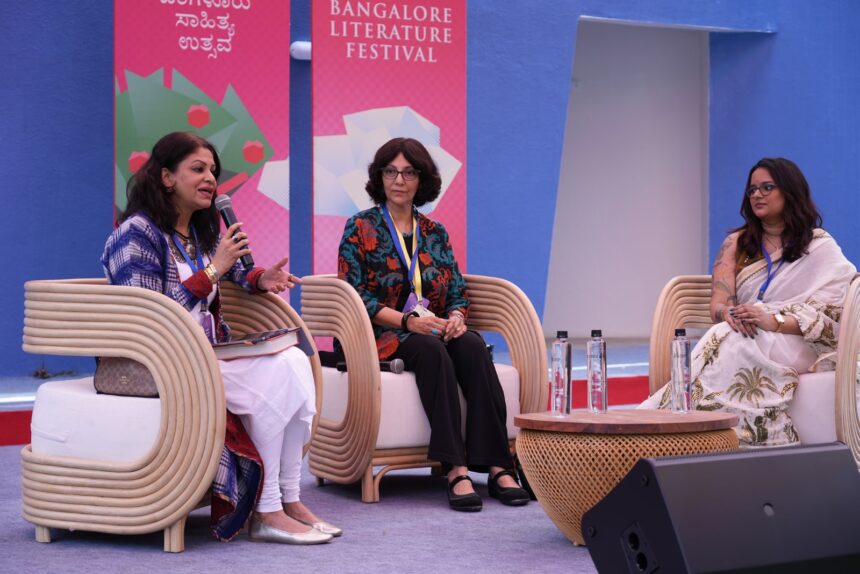
Food and its evocative tales are often referred to as the barometers of cultures. The culinary arts bear a syncretic relation with everything that we experience. Our lives, our experiences and our stories, our ecology and the future we behold. The archiving of these anecdotes and pristine pieces of wisdom laid the foundations for this panel discussion on the launch of two new books, The Coorg Table by Kaveri Ponappa and Adukala by Tia Anusuya.
Dipped in the nostalgia of three generations, the discussion moderated by the acclaimed danseuse and artist Madhu Nataraj, softly touched upon the different approaches to archiving food stories and exploring their relationship with the lived experiences of her esteemed guests.
While Kaveri, an acclaimed author and independent writer on food, wine and heritage visualised food through its social and cultural contexts, Tia, a Corden Bleu chef by profession, spoke about the importance of preserving food stories through the wispy lens of a warm relationship she shared with her late grandmother.
When asked about the idea behind visualising the “table” as a metaphor in her book , as a space of sensory and social experiences, Kaveri fondly recalled the table as a place where all her experiences related to food emanated from. Where one imbibed a taste of tradition and where culinary knowledge was passed on through the act of tasting, eating and remembering.
“I think food is one of our direct entries into a place and its memories and into the memories of the people behind the food”, said Kaveri emphasising the duality of both our personal and our collective community memories that make up this beautiful pool of culinary knowledge and inheritance in the form of recipes. Softly rebutting the notion of a recipe to be a wry set of measurements, she referred to them as broader narratives of cultural histories drawing applause from the audience as she outlined the cultural moorings of the legendary Kodava Pandhi Curry and the Smoked Dried Pork. “Food is a visual archive of love and human survival”, summed up Kaveri to profuse applause as Madhu quoted a short moving passage from her book.
Madhu transitioned to Tia’s book Adukala (Malayalam for Kitchen) requesting her to share the story behind her first book. Sketching her grandmother as a loud proud Malayalam matriarch with a quiet resilience, Tia recalled how the pause that Covid offered, sparked conversations around food with her grandma, revealing a river of tales about people and memories of her family which Tia found herself compelled to archive. Suffused with subtle imagery Tia described her labour of love a race against time given the failing health of her grandmother. The journey exposed Tia to endless stories of unsung selfless homemakers, who she felt, hadn’t got their due from the society that they had served to build quietly.
Madhu lent an astute perspective to the discussion by bridging a connect between the culinary and performing arts through the concepts of Navarasa in Natyashastra and the Shadarasas in Charakasamhita prompting both the guests to acknowledge the transcendence of concepts like sensory tastes and experiences.
Recalling Kavita’s lineage as a preserver of Kodava heritage, Madhu asked her how, in the complex alchemy of food and traditional wisdom, culinary stories etched their space in social norms and if through her new book she aspired to renew a sense of connection in young Kodavas with their beleaguered culture. Kavita quoted Robin Kimmerer, and her “reciprocal relationship with the living” to explain why all of us are in the responsible stewardship of our culinary heritage as a living & breathing expression of who we truly are. “The hunger that we have is for a place that each food reminds us of”, Kavita spoke, to another round of applause from a visibly moved audience, describing food as a translator of culture used to express who we are.
Referring to Tia’s quote about the importance of the home chefs in her book Madhu steered the conversation deftly towards gender disparity in home versus commercial kitchens. Tia outlined the stark difference between the solitary nature of this activity at home vis a vis the delegated spread in a commercial kitchen and in the painful beauty of being an unappreciated homemaker serving out love each day. Regaling the audience with the description of a balmy Mamallaserry morning, Tia recounted her grandma’s anecdotes as she soberly likened her to “a calm river that washed away yesterday’s sins” while she recited a small portion from her book to an applauding audience.
With her eye on the clock Madhu asked both the guests how in the age of homogenised food culture, artists like them, as receptacles of generations of culture, are manoeuvring with the living political and social changes around them on their art. Kavita, while confessing to the pressures on heritage by a fast homogenising global food culture, retained her faith in the wisdom of the generation in reclaiming their roots. While quoting the story of the celebrated Chef Thimmaiyya (seated in the audience) she averred that many young people were dedicating themselves to preservation of rare food items and upskilling themselves in growing food. Tia crisply responded by saying that the only way to stem the homogenisation was for all of us to slow down.
The session ended with time left for just one audience question which was directed towards Tia. On being asked about the preponderance of gender in her book and if it furthered the gender bias that existed in home kitchens, Tia acknowledged the observation and felt that the onus was on everyone to steer out of this bias while also pointing out the dichotomy of home kitchens led largely by women and the commercial kitchens led by predominantly by men.
Rahul Rishi Kaul
Former private banker. Serial Entrepreneur. Photographer & Ad filmmaker. I run an independent content production house called The Yellow Picture. I’m a voracious reader and consumer of books and cinema. I hold a subtle flexible view on literary art but I’m opinionated on cinema. Love poetry and history with equal grace.