
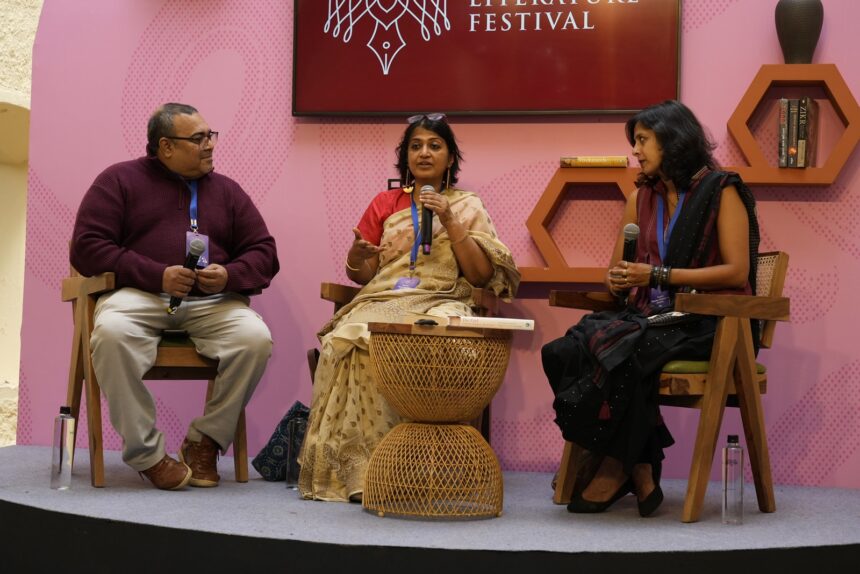
Mental health conversations often begin with heaviness, but this session began with humour when the moderator broke the ice with a joke about his own weight before inviting us into a dialogue that was honest, expansive, and deeply grounding.
Aruna Gopakumar is a Transactional Analyst in the field of psychotherapy and the author of the book “And how do you feel about that?”. When Sabin opened the conversation with the question “How big is the mental health problem today?”. Aruna responded with a quote from Thoreau, “Most men lead lives of quiet desperation and go to their graves with the song still in them.”, indicating that people often resign themselves to the worlds they know, unable to imagine alternatives. But the more we speak, the more the world shifts.
Mental health, she insisted, is systemic. The real question isn’t just “What is wrong with me?” but “What context shaped this for me?”. Hope, she said, lies in collective action.
The conversation then moved to our next guest Ragini Tharoor Srinivasan, the author of the book “The End Doesn’t Happen All At Once”, a collaborative pandemic memoir co-written by Ragini and Chi Rainer Bornfree. Over four years, they exchanged weekly letters about life as writers, teachers, and mothers to young children navigating the chaos of Covid.
The book unfolds in real-time, not as a novel, but as a human document of two people witnessing themselves and each other.
Ragini drew a parallel stating that therapy, too, is dialogical, in that it is a process of seeing oneself through another mind, another language, another mirror.
When Sabin asked Aruna to explain further about her therapy modality TA (Transactional Analysis), she described it as an approach to psychotherapy grounded in context. Human behaviour, she emphasised, cannot be understood in isolation from the world that welcomes (or wounds) us. She spoke of how we interpret the world through the intuition of the child we once were, absorbing cultural, familial, and generational scripts. She explained further by quoting an example from one of the stories in her book of a father seeking help because his son refused to bathe before school. The presenting issue was simple, but behind it lay inherited norms, outdated expectations, and layered meanings.
Sabin enquired about the therapeutic power of stories, to which she beautifully explained how the letters in the book, written from May 2020 to 2024, allowed her and Chi to view life with distance and integrity. Writing is not just expression; sometimes, writers become their own first readers. In a post-letter-writing age, addressing a known other through a letter becomes almost a radical return to mindful narrative.
On incorporating art in therapy, Aruna said something profound: words are a limited language. Many people feel, sense, and know things that cannot be contained in sentences. Movement, scribbling, drawing can bypass defences and open forgotten rooms within. And therapy shouldn’t be confined to a room, she added. Reflection and journaling are to mental health what exercise is to physical health.
A question on anger shifted the tone. Aruna explained anger as a survival emotion and not weakness. Angry people are often frightened, wounded, or overwhelmed. Ragini added that there’s also genuinely a lot to be angry about, on which the audience applauded in unison in agreement. Aruna agreed that anger is needed, important, and purposeful.
Sabin then asked another pertinent question to Ragini about the importance of resilience, especially during the quarantine days. Ragini said that while she does not personally use the word resilience as much, she knows that her co-author Chi views their book as a practice of survival. She also added that the pandemic forced us to confront interdependence, not in a romantic way, but as a lived truth. According to her, writing together about regrets, fears, hopes and desires helped both authors tend to their own lives while listening closely to another’s.
Sabin quoted a few examples of sports personalities like Robin Smith and Jemimah Rodrigues and their mental health struggles which led to the important question “When is therapy needed?”. Aruna’s answer was beautifully simple, “Whenever you become curious about yourself.” She also added that in collective cultures like ours, support can come from many sources like religion, faith, traditions, community. Therapy is just one of them, not the only one. Ragini added that the motivation lies in exploring one’s relationship with the self, others, and the world.
The session was then opened to audience questions which were equally insightful. When asked about stigma, Aruna said that mental health is a generational, universal experience that we must first recognise and then attend to. Therapy is not a sign of weakness.
A question followed about religion losing its role as a ‘therapist’. Aruna replied sharply that any kind of power always leads to corruption. Religion has power, and so can therapists. Without ethics, anyone, even a therapist, can become exploitative.
When asked how caste and social structures influence therapy, Aruna insisted that mental health is never just “intra-psychic.” Therapists must be aware of social realities and decolonise their practice. The personal is political, she said. Ragini added that the model must be one of horizontality, an equal and humane relationship.
The final question asked whether healing must always be painful. Aruna said that it can be both. Ragini confirmed that two things can be true at once.
Another panelist Nina Verma, who was supposed to be in the session but could not make it due to the flight cancellations, shared a message with the audience about her latest book, “Rise by Nina Verma — exploring grief, growth, and grace” and encouraged audiences to pick and read it.
As the session ended, one truth echoed softly that resilience is not a solitary achievement. It is shaped by stories, nurtured by connection, and strengthened every time we speak gently, honestly, collectively.
Neha Agrawal
A former IT Engineer and now a practicing Counselling Psychologist since 2025. I have over 22 years of life and corporate experience, including contributions as a leader, consultant and trainer in education spaces, NGOs, DEI (Diversity, Equity, & Inclusion) and women’s empowerment. I have also co-authored a book ‘Periodwonderland’ – a graphic comic novel. I also occasionally write books for CBSE and blog for events like BLF. My other interests include traveling to the mountains and forests, teaching children, meeting people to understand them deeper, art and cultural spaces and reading.
Email: writetoneha@gmail.com | LinkedIn: agrawalneha | Instagram: one_conversation_at_a_time