
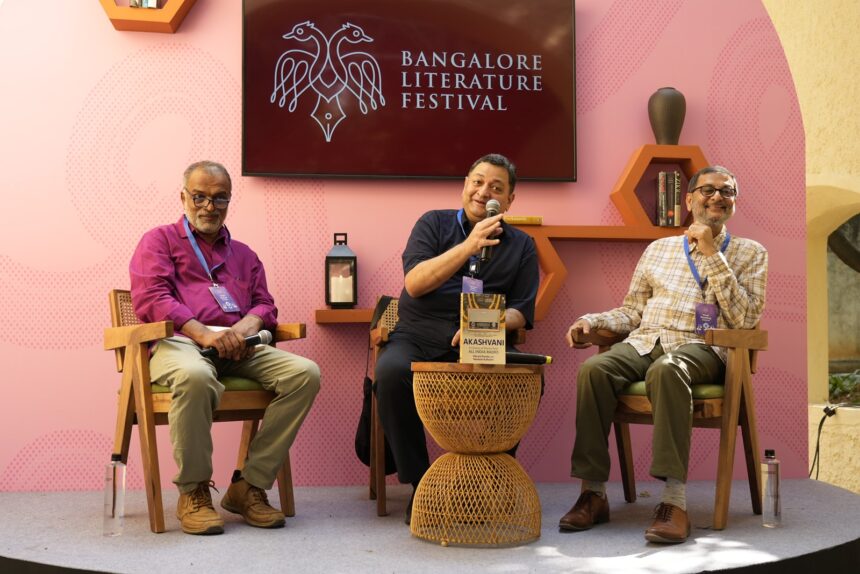
As the audience settled for the session to begin, the moderator Udayan opened the event by playing the original Akashvani signature tune, the one that got aired every morning at 5:58 AM during the AIR (All India Radio) days. The ambience was filled with nostalgia, melody and so much recall! The audience was a surprising mix of not just Boomers but Millennials and Gen Zs too.
This signature tune, as Udayan informed us, was composed in 1936 by Walter Kauffman, a German-Jewish musician exiled from Hitler’s Germany and is based on the raga Shivranjani.
Akashvani turns 100 this year. And marking this milestone a new book “Akashvani : A Century of Stories from All India Radio” by Vikrant Pande and Neelesh Kulkarni has been published this year. It was displayed on the table vertically and the cover had a quaint picture of an old radio. It is a slim, engaging, surprisingly fun read that traces the history of India’s national radio service.
Though the authors couldn’t make it to the session due to flight disruptions, the new station masters, Udayan, Abdul Rasheed, and Vivek Shanbhag made up for it and brought the book alive. They spoke of Akashvani before independence, when programming was governed by British policies, and of its post-independence shift when it began to reflect the voice of a changing nation.
Abdul Rasheed has spent 36 years at Akashvani in programming. While most imagine radio as a studio-bound world, Rasheed was out in the field, reporting from Shillong and across the North-East, bringing stories home to the newsroom.
He explained how the Radio News Units (RNUs) functioned, a mix of national bulletins, regional translations, hyper-local reports, and synchronized timings that made radio feel like the country’s heartbeat. Before Doordarshan, before morning newspapers reached homes, the radio bulletin was the source of live news.
Vivek Shanbhag, one of India’s most admired contemporary writers, spoke of Akashvani’s deeper imprint — the way sound shapes imagination. According to him, the most important contribution of radio was how it shaped the imagination of millions of people and how it is personally very important to him as a writer. Engaging with one’s imagination makes it very personal. As an example he shared just listening to the cricket commentary without the visuals led to long animated discussions in groups. He also shared another interesting story as a Konkani speaker. He recalled tuning into a weekly 9:30 PM Konkani programme every Sunday. It was more than entertainment; it was dignity. A feeling that his language and community mattered.
The conversation glowed when Rasheed described Halli Radio, his popular weekly programme. Growing up a “nomad boy” in Coorg, he went on to become a “radio boy” for entire villages that had no access to news. He would ride into remote settlements unannounced, gather villagers around a fire at 9 AM, broadcast live, capture their stories of bonded labour, folk songs, struggles, joys etc and carry their voices far beyond the village.
That, as Udayan put it, was Akashvani’s genius, participation and inclusivity.
Udayan’s own memories of discovering cricket through radio in the 1971 England tour were a reminder of how radio once created worlds with sound alone. Skilled commentators didn’t just describe a match; they built a dreamscape you stepped into.
The discussion then moved to the two most popular programs of AIR times: Binaca Geetmala and Jaimala, where soldiers and their families could request songs, creating moving bridges of connection across distances. For many Indians who didn’t own record players, Vividh Bharati was the only gateway to music. It introduced listeners to classical compositions, unusual songs, and unexpected playlists. The joy of surprise radio curation that today’s algorithmic world has lost.
Rasheed had innumerous stories to share, of which, he shared some emotional and funny ones too. One such story was of a man from Lakshadweep who entered a studio for the first time and wept, remembering how, as an “untouchable”, he was once made to sit in a mosquito-filled side room just to hear a neighbour’s radio. Another one was about a woman who brought Rasheed a basket of fruits, ghee, milk etc. travelling miles just to meet him only to be disappointed that he wasn’t the young, handsome man she had imagined from his voice. Also, once he went to a cigarette shop and someone recognised him by his voice.
Yet another interesting story was about a postman who wrote fifty letters in a single day to a programme after collecting names from all the villagers and listing them in the letter. The radio team had to use a magnifying glass to read them all.
Vivek pointed out that the maximum number of inland letters came from Agartala surprisingly.
The session then was opened for audience questions. An audience member asked why radio has been overshadowed by satellite channels. Rasheed and Udayan pointed out that while the market may no longer sell radios, we’ve simply shifted to apps, podcasts, car stereos. The platform has changed, not the impulse or audienceship.
As the conversation wound down, it felt less like an event and more like a collective nostalgia. A tribute to a medium that held this country together through news, through music, through imagination.
And as we left the hall, that 5:58 AM tune still hummed softly somewhere within a reminder of the quiet power of a century-old institution called Akashvani.
Neha Agrawal
A former IT Engineer and now a practicing Counselling Psychologist since 2025. I have over 22 years of life and corporate experience, including contributions as a leader, consultant and trainer in education spaces, NGOs, DEI (Diversity, Equity, & Inclusion) and women’s empowerment. I have also co-authored a book ‘Periodwonderland’ – a graphic comic novel. I also occasionally write books for CBSE and blog for events like BLF. My other interests include traveling to the mountains and forests, teaching children, meeting people to understand them deeper, art and cultural spaces and reading.
Email: writetoneha@gmail.com | LinkedIn: agrawalneha | Instagram: one_conversation_at_a_time