
“The pause on my lips
You fill in what you feel”
James Shea read this two-lined poem during the session, and in a way it captured the entire theme of the conversation. A poem that leaves space. A poem that invites the reader to step in. And that became the heart of the conversation on silence, sound and everything that lives in between the two.
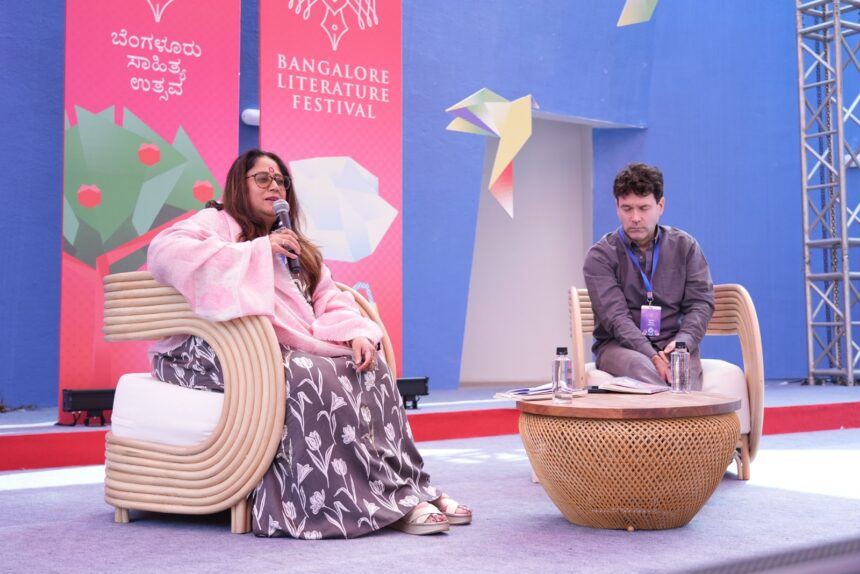
James Shea is a Hong Kong based poet originally from the US, known for his quiet, experimental style and the way he works with pauses and attention. Shikha Malviya, the moderator, is an Indian-American poet. Her work often weaves history, identity, and personal memory. Their pairing made the session rich and balanced.
It was the first session of the day at Freedom Park. Shikha was quick to point out how fitting it was to speak about freedom of expression in a place where people were once imprisoned. Poetry, she said, has always carried something rebellious.
The session opened with a simple question. What does it mean to be a poet standing between silence and song? James said people often imagine it as a clear divide, but it never is. He brought up John Cage’s composition 4’33” where performers were instructed to not play for the entire duration, and the “noises” of the audience became the music. The lesson, he said, is that silence is never empty. “There is never a blank page or an empty mind,” he pointed out.
To show how silence works in his own writing, James read his poem Tinnitus:
“Poor ear my own instrument
A note held for a lifetime
An experimental sound at a constant pitch
As if I was constituted by piercing”
He then went on to read another poem, Sunbroker:
“Lifeguards can’t save themselves
from their own wasting.
What’s my record
of attending to the world?
A mute pool in winter.
Is wisdom efficient?
The sun’s beams reach
the patio in a tie.
What I need is a continuous ray of light at my side.
A chance to make up
for the luxury of not understanding.”
He said the poem draws attention to pauses, and how important it is for readers to take the leap with the poet to the next point in a poem.
When asked what goes into writing a poem, Shikha described the space between silence and song as a kind of “meditative zone”. “Thoughts move in and out while doing ordinary chores. But rumination goes on and then desolation, followed by actual sculpting,” she said. Answering the same question, James said he believes in rewriting. He lets language lead him through. Shikha pointed out how different every poet’s process can be.
James then turned the conversation towards Shikha’s latest work on Anandibai Joshee, one of India’s earliest women doctors. He asked her about the silence around such figures because they are not spoken about enough. Shikha talked about another kind of silence, which is erasure. When stories are hidden, we have to search for them. She recalled facing bullying and racism as a child in the USA. People told her to go back where she came from. That question led her to look deeper into history. During her search she found a photograph of three women in Philadelphia: a Japanese woman, a Syrian woman and an Indian woman in a saree. All of them doctors. Intrigued by the image,she decided to dig deeper into her life.
Her first poem in the book is titled When they ask us to pose for a photograph at a women’s medical college reception:
“Forgive us if we don’t smile
the ocean’s scent still on our clothes
still on our clothes the stench of sea
we, visitors of another clime
of warmer lands are we
with pride, we wear our native clothes
silks and jewels we proudly don
saree, kimono, headdress of coins
with lyre, sash, a handheld fan
no scalpel, stethoscope or degree
three female doctors of foreign pedigree
playing dress-up for Western eyes
in our appearance, they see worlds wild
forgive us if we don’t smile”
She spoke about her poem as an ode to that iconic photograph of three women in their native attire at a medical college reception. She wanted the poem to feel as if the photograph was speaking directly to the reader. It came from a time when ideas of “exoticism” shaped how women like them were seen, and she wanted the poem to cut through that gaze with clarity.
The session moved to the Question-and-Answer segment where one of the budding poets in the audience asked about the process of writing and publishing poems.
Both poets offered advice:
- The first poetry collection can usually be around 45 to 90 pages.
- Write many poems before worrying about themes.
- Later, look for threads that naturally link them.
- The order of poems matters, so treat sequencing with care.
- Share drafts with trusted friends.
- Revision shapes the work. Let the poems breathe.
- Read widely. Reading is as important as writing.
- And finally, be brave enough to put your work into the world.
As the session came to an end, the contrast between their work stood out in a gentle and honest way. Shikha’s poems grow out of years of research and a deep desire to give voice to someone history had pushed aside. James’s poems, on the other hand, rise from his own experiences, observations and the small moments that stay with him. One builds slowly from fact, the other moves freely through thought and sound. Yet both showed how poetry can hold silence and song at the same time, and how two very different paths can still lead to the same place of feeling seen and understood.