
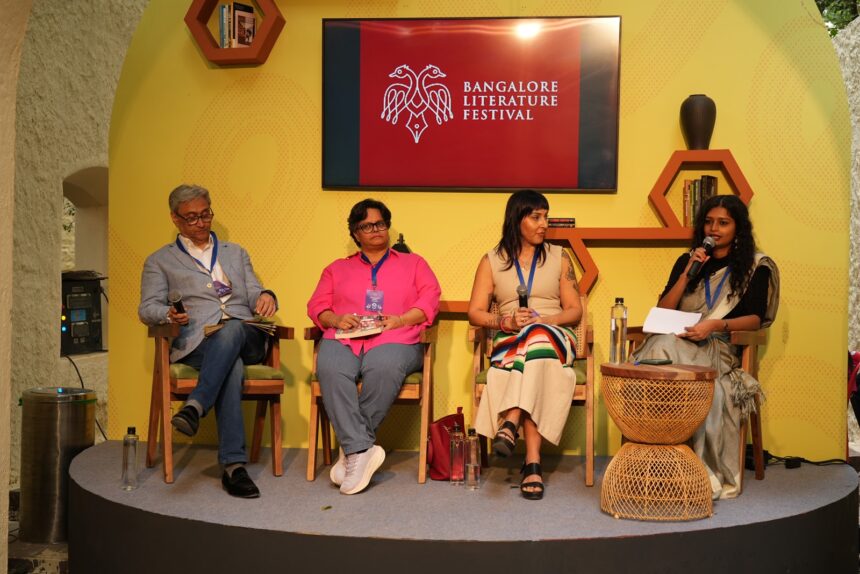
In the age of ever-reducing attention spans, relying on memory is tricky. And here we have a session where three writers made a bold decision to write memoirs.
The session was a treasure trove of stories from three very different people. Rani Neutill, who writes about the story of her intergenerational trauma, Sangeetha Vallat, who writes about her days in the railways, and Lav Bhargava, who writes about his life as a politician, actor, and, most importantly, the love and loss of his wife.
When asked what inspired them to write their memoirs, here is what the writers had to say:
Rani Neutill (Author of Do You Know How Lucky You Are)
Rani said she was compelled to write her book to understand her mother and to understand how the women in her family became who they were. For her, it was about contextualising the women in her family.
Sangeetha Vallat (Author of Platform Ticket)
Sangeetha said she is a reader first. She began to pour her heart out when her father passed away and she was travelling alone on those train journeys.
For her, the book is a dedication to her fourteen years of experience in the railways and to the anecdotes of colleagues who often don’t get a second glance.
Lav Bhargava (Author of A Life Less Extraordinary)
He began his memoir to cope with the loss of his wife. He wanted to write not just about her wife or himself, but also about the life the two spent together.
After his wife was shot, he spent twenty-five daunting days in the corridors of the hospital, knowing she would not survive.
Fate had a different path. After losing the entire manuscript on his iPad and restarting it in 2020, the book came to life again. In his words, destiny has a different story.
When asked how he could be so candid in his book and whether anyone ever questioned him about the portrayal, he replied with humour, “Nobody would dare to.”
Rani Neutill
When asked about the dilemma of being vulnerable to the world, she said, “If a story has to be told, the messy parts have to be shown. To find a balance in the victim versus villain narrative, she said the political context is important.”
Sangeetha Vallat
When asked how the experience and the book would be different in the current context, she said it would be very different because the technology has progressed faster than people can adapt. The adrenaline of sending someone back with a confirmed ticket is not the same today, and people were much kinder then.
She recalled with nostalgia how writing the book helped her reconnect with her old colleagues. She scribbled their conversations in their entirety, as she was not tech-savvy.
“It is about humanising the people behind the counter,” she stated.
She mentioned with a laugh how her habit of rote learning helped her recall the stories and write the book.
Lav Bhargava
When asked about his writing process, he said that people have many ways of remembering things. For him, it is through narrating the same stories to his friends and family. His talent for remembering faces and phone numbers helped him in unexpected ways.
He spoke about his interactions with people from all strata of life and how it is always a mix of good and bad. He said he never compromised in his life, and that gave him contentment. “Not being able to lie is a problem for a political career, and that Seva Bhav is not the only thing needed in politics,” he added.
The seeds of wisdom that came from him were simple: “Free will is there, but the result is preordained.”
Rani Neutill
When asked about how she felt after completing the book, she said the process was slow for her. Learning how to find a narrative and structure was the challenge.
Sangeetha Vallat
On her life in the railways, she relived how bathroom breaks were difficult and how she was the only woman on the staff. From taking the keys from the station master to using the cracked green bucket in the washroom, she explained the whole quest with humour.
Her memory shines in how she remembers the name of the TTE, Mr Charles, the first person to wish her Happy Women’s Day.
She spoke about how small acts of kindness occupy a big place in people’s hearts, recalling the Women’s Day celebrations she organised at the Chennai railway station.
Lav Bhargava
One of the most interesting moments was when Lav explained his brief encounter with Dawood Ibrahim at a cricket match and how Dawood expressed his desire to return to India and asked him for help.
What They Chose Not To Include
When asked about what they left out of the memoir, both Sangeetha and Lav said their next books will explore those parts. Sangeetha said with a laugh that she avoided writing about her elopement because she did not want to anger her mother.
Overall, the session allowed the audience to relive memories alongside three people who have lived full and complex lives. It reminded us that remembering is not only about looking back. It is also about making meaning out of what life hands us.
Sharmila Giduthuri
Sharmila works in the automotive domain as a Senior Research Engineer at Mercedes Research and Development. She has been an active member of several non-profit organisations since 2019. She is currently writing her first book and also works as a freelance graphic designer.