
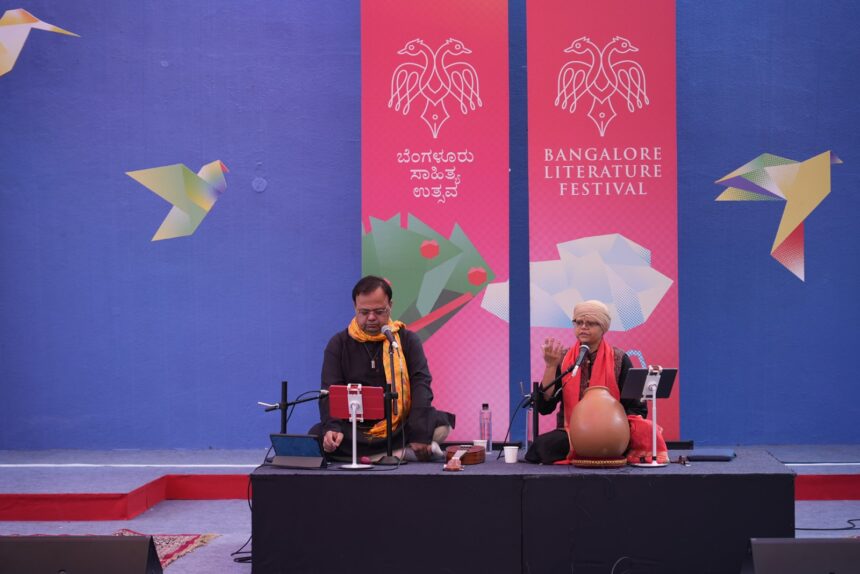
“There is something grounding about clay — humble, elemental, timeless.”
Long before books or paper existed, clay held water, nourishment, ritual, and memory. A beautifully calming session unfolded around this very element, drawing us into the world of the ghatam, the claypot that sings.
Sadhana Rao, our moderator for the session, herself exudes grace and poise along with very thought provoking questions that led to engaging flow of the event. The session opened with a simple idea that sound begins long before performance. It begins in the womb of the earth. “Song of the Clay Pot” is a memoir-travelogue by our guest Sumana Chandrashekar, that explores this truth. It traces not just the making of the ghatam, but the making of an artform, a tradition, a genealogy of sound that is as old as the riverbeds that hold clay.
Sadhana invoked a “do re mi” moment as she asked the author to share the journey of the instrument and the structure of the book. There is a circulatory, almost organic rhythm to the way this book is written. The ghatam, she explained, is often compared to the human body. Its index reflects the five elements that shape us.
Sumana spoke of the pot (ghatam, matka) as a recurring symbol across traditions, from the Upanishads to Bhakti literature, from Sohni Mahiwal to Vachanas and Baul songs. She also explained how Saint Kabir returned to this metaphor constantly in his writings and poetry referring to the leaking pot, the fragile pot, the pot made of five elements similar to our beings as humans. Across Asia, various other mystics have likened the human body to the pot by drawing parallels to their common qualities of being porous, vulnerable, and sacred. Children, she said, intuitively understand this connection because it lives in our cultural consciousness.
The book mirrors the making of the ghatam in five stages, ending with the pot breaking and returning to creation. In many ways, the book itself is a ghatam.
When asked what drew her to the sonic landscape of the ghatam, her answer was deeply intimate. Trained as a classical vocalist, she reached a moment of inner unraveling for a deep search for meaning. In that period, she began to smell earth on her fingers, to hear the sound of the pot in the quiet of the night. A sensorial calling, she said, which was surreal and irresistible. That is when she sought her guru, and the journey began. She also shared that as a vocalist, voice is something one can only feel, not see. But when she held the ghatam as an adult, she felt that she had arrived in her body. From heels to head, she felt her entire being participating in the music like a homecoming into the wisdom of the body, the corporeal intelligence we often forget we hold.
Sadhana highlighted that one of the most sensitive chapters in the book is titled “Geographies in the Making.” A musical instrument is noticed only when artists hold it. The conversation around it was mesmerizing.
Clay in pottery and decorative sense is well known but Sadhana requested Sumana to explain the value of clay as an element of sound.
Sumana was amazed that Sadhana found that chapter most sensitive and evocative. Sumana explained that clay is everywhere around us while we barely notice it. But to seek the sound of earth is a sonic geography, an exploration of where clay comes from, what histories it carries, what land it belongs to. She also shared that her search took her to the source of the ghatam: Mana Madurai, one of the three historic centres of ghatam making. The other two, including Devanahalli and the famous Madras ghatam that have unfortunately now gone extinct. Each ghatam’s sound shapes the playing technique. A strong, thick pot allows a different musical vocabulary than a delicate one. The instrument itself dictates how it wants to be played.
The conversation turned to gender and the patriarchal structures that have long shaped performance arts. Sumana believes that women percussionists are finally finding space. But structural changes on stage and in pedagogy have a long way to go. Should women bring their own aesthetic, their own physicality, their own lived experiences into percussion? How does the nature of a female body shape rhythm? All these questions have to be further explored. Often, women absorb the dominant (male) energy of the field. The question now is how to create space for a different rhythm, a different voice.
Sumana added that one of the most striking aspects of her process is how seamlessly she blends practitioner knowledge with research.
“My classroom became the site of my research,” she said.
“My body became the site of my research.”
Rather than separating scholarship from lived experience, she marries the two. She strongly promotes having a feminist framework that values fluidity over hierarchy. In most traditions, researchers and practitioners stand on different sides. She dreams of bridges, linkages, conversations that enrich musicology with lived, body-based knowledge.
This, Sumana believes, is the future of music research. Sadhana added “I hope education policy makers are listening.”
The session ended with a live demonstration of the warm, earthy resonance of the ghatam filling the room along with the soft beautiful smile of the player, Sumana Chandrashekhar. Each tap, stroke, and vibration felt like a reminder:
Clay remembers.
Clay responds.
Clay sings.
And through it, so do we.
Neha Agrawal
A former IT Engineer and now a practicing Counselling Psychologist since 2025. I have over 22 years of life and corporate experience, including contributions as a leader, consultant and trainer in education spaces, NGOs, DEI (Diversity, Equity, & Inclusion) and women’s empowerment. I have also co-authored a book ‘Periodwonderland’ – a graphic comic novel. I also occasionally write books for CBSE and blog for events like BLF. My other interests include traveling to the mountains and forests, teaching children, meeting people to understand them deeper, art and cultural spaces and reading.
Email: writetoneha@gmail.com | LinkedIn: agrawalneha | Instagram: one_conversation_at_a_time